PromptGate
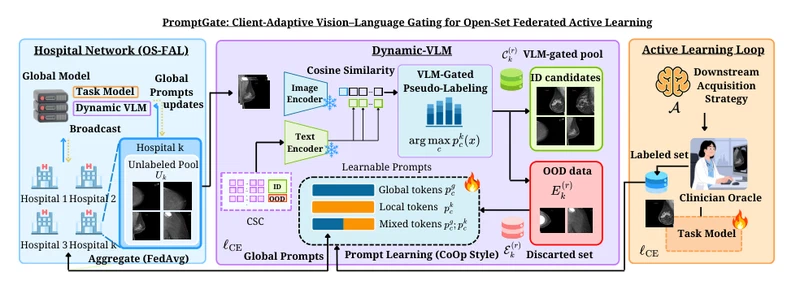
PromptGate tackles open-set federated active learning, where each client holds a private unlabeled pool contaminated with out-of-distribution (OOD) samples and artifacts. The goal is to spend a limited annotation budget on in-distribution (ID) candidates while keeping client data private.

License
MIT
Research themes
People

Overview

PromptGate tackles open-set federated active learning, where each client holds a private unlabeled pool contaminated with out-of-distribution (OOD) samples and artifacts. The goal is to spend a limited annotation budget on in-distribution (ID) candidates while keeping client data private.
At the core is a VLM gate built on a frozen BiomedCLIP backbone (image + text encoders). Cosine similarity between image features and prompt embeddings yields VLM-gated pseudo-labels that separate the unlabeled pool into ID candidates and OOD / artifacts, so the active-learning oracle is only queried on likely-ID samples.
Gating is driven by client-adaptive learnable prompts, which decompose into:
- Global tokens — shared across clients via FedAvg.
- Local tokens — kept private and never leave the site.
- Mixed tokens — combine global and local context (with a Class-Specific-Context / CSC variant), replacing the static text-prompt baseline.
A few shots of ID/OOD labeled data tune these prompts via CoOp. The downstream task model runs each active-learning round (inference → training), and its parameters are shared via FedAvg, while a clinician oracle labels the queried ID candidates. PromptGate is agnostic to the acquisition rule and is evaluated with Random, Entropy, FEAL, PAL, LfOSA, and OpenPath.
Using the code
The repository README covers environment setup, install the remaining requirements, datasets & attribution, out-of-distribution (ood) setup, usage. See the repository on GitHub for step-by-step instructions.
Related publications
PromptGate: Client-Adaptive Vision–Language Gating for Open-Set Federated Active Learning
Medical Image Computing and Computer Assisted Intervention – MICCAI 2026, Lecture Notes in Computer Science, 2026