FUTURE-AI: International guidelines for trustworthy medical AI
International consortium of 117 experts from 50 countries that defined FUTURE-AI, the first international consensus guideline for trustworthy and deployable AI in healthcare — six guiding principles and 30 best practices across the AI lifecycle (BMJ 2025). We contributed as a consortium member.
Abstract
Despite major advances, few AI tools for medical imaging and healthcare have been adopted in clinical practice, partly because of concerns about their robustness, fairness, transparency and accountability. FUTURE-AI set out to give developers, evaluators, clinicians and regulators a shared, actionable answer to the question: what makes a medical AI tool trustworthy and deployable?
The consortium
The FUTURE-AI Consortium was founded in 2021 from five European imaging projects of the AI for Health Imaging (AI4HI) network — EuCanImage, ProCAncer-I, CHAIMELEON, PRIMAGE and INCISIVE — and grew into an international, interdisciplinary group of 117 experts from 50 countries on all continents: AI scientists, clinicians and clinical researchers, biomedical ethicists, social scientists, legal experts and data managers. The guideline was developed over 24 months with a modified Delphi approach: six working groups drafted definitions and initial best practices for each principle, which then went through eight rounds of surveys, feedback and online consensus meetings.
Objectives
- Define widely accepted guiding principles for trustworthy AI in healthcare.
- Translate them into concrete, actionable best practices that cover the entire lifecycle — design, development, validation, regulation, deployment and monitoring.
- Provide a dynamic framework that can evolve with the technology, regulation and stakeholder feedback.
Principles and recommendations
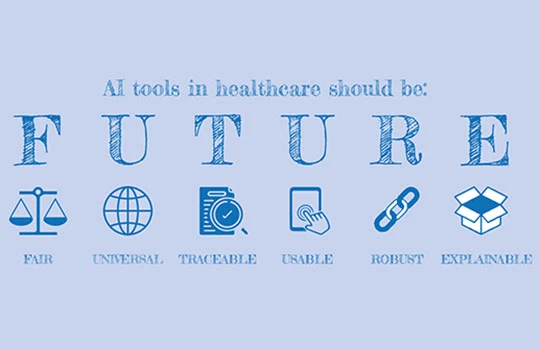
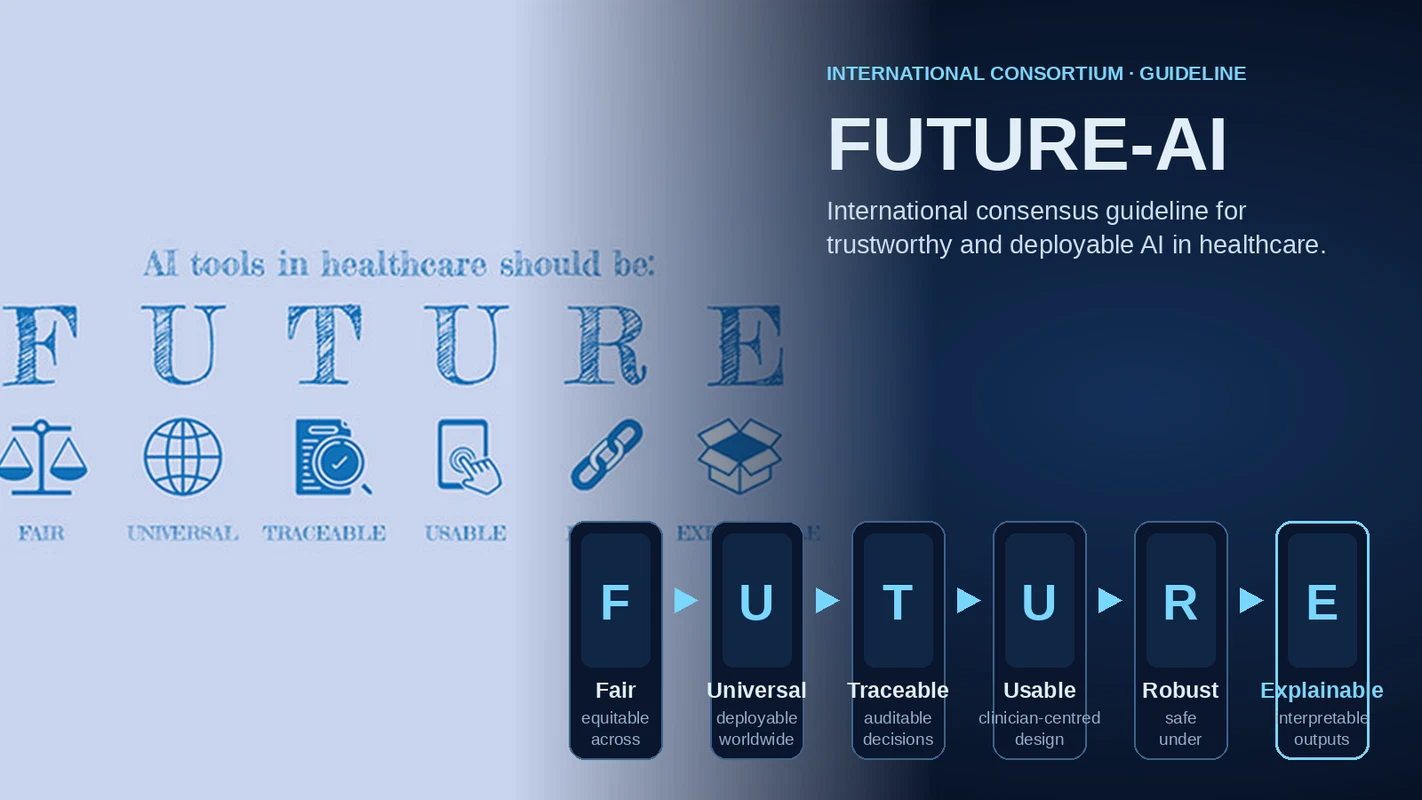
FUTURE-AI rests on six principles — Fairness, Universality, Traceability, Usability, Robustness and Explainability — operationalised in 30 best practices that address technical, clinical, socio-ethical and legal dimensions. Among them:
- Fairness: define potential sources of bias from an early stage, collect information on individual and data attributes, and evaluate biases and correction measures.
- Universality: define the intended clinical settings, use community-defined standards, evaluate on external datasets and multiple sites, and demonstrate local clinical validity.
- Traceability: implement a risk-management process throughout the lifecycle, documentation, quality control of inputs and outputs, periodic auditing and updating, usage logging and AI governance.
- Usability: define intended use and user requirements early, establish human–AI interaction and oversight, provide training, and evaluate user acceptance and clinical utility and safety.
- Robustness: define sources of data variation early, train with representative real-world data, and evaluate robustness against real-world variations.
- Explainability: define the need for explanations with end users and evaluate them with end users.
Seven general recommendations apply across all principles: engage interdisciplinary stakeholders throughout the lifecycle, protect data privacy and security, address identified AI risks, define an adequate evaluation plan, comply with AI regulations, and investigate application-specific ethical as well as social and environmental issues.
Our role
Shadi Albarqouni took part as a member of the FUTURE-AI Consortium, contributing to the consensus process and co-authoring the guideline (Lekadir et al., BMJ 2025); the initiative itself was led by Karim Lekadir (University of Barcelona). The principles — in particular robustness, fairness and universality across sites — closely match the lab’s work on federated and affordable AI and inform how we design and validate our own tools.