Conference
CORE A
❝ citations
Semi-supervised deep learning for fully convolutional networks
Medical Image Computing and Computer Assisted Intervention – MICCAI 2017, Lecture Notes in Computer Science, 2017
Abstract
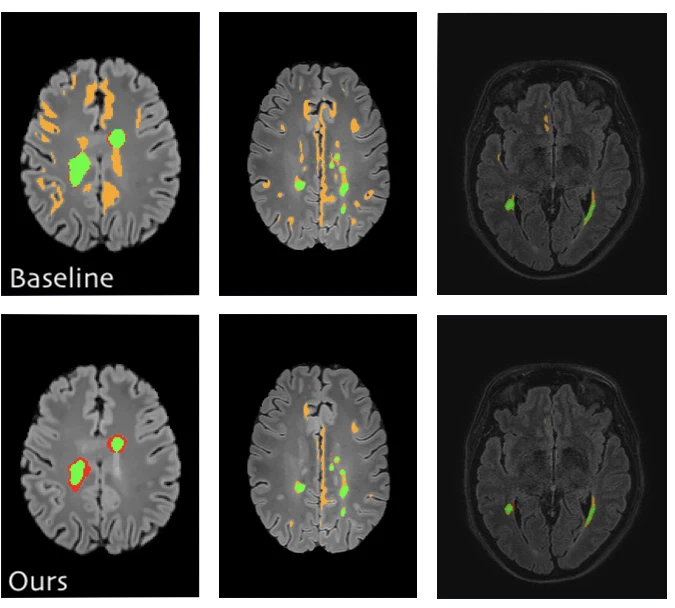
Deep learning usually requires large amounts of labeled training data, but annotating data is costly and tedious. The framework of semi-supervised learning provides the means to use both labeled data and arbitrary amounts of unlabeled data for training. Recently, semi-supervised deep learning has been intensively studied for standard CNN architectures. However, Fully Convolutional Networks (FCNs) set the state-of-the-art for many image segmentation tasks. To the best of our knowledge, there is no existing semi-supervised learning method for such FCNs yet. We lift the concept of auxiliary manifold embedding for semi-supervised learning to FCNs with the help of Random Feature Embedding. In our experiments on the challenging task of MS Lesion Segmentation, we leverage the proposed framework for the purpose of domain adaptation and report substantial improvements over the baseline model.
Interactive explainer
Coming soon. An interactive Slidev walkthrough of this paper — with live, explorable figures — will appear here.
Authors: set
slidev: in this page's front matter to the deployed deck URL.Research themes
Keywords
RadiologyMedical ImagingDeep LearningSemi-Supervised LearningDomain Adaptation
Lab authors


Cite (BibTeX)
@inproceedings{baur2017semi,
 author = {Baur, Christoph and Albarqouni, Shadi and Navab, Nassir},
 booktitle = {International Conference on Medical Image Computing and Computer-Assisted Intervention},
 organization = {Springer, Cham},
 pages = {311--319},
 title = {Semi-supervised deep learning for fully convolutional networks},
 year = {2017}
}
Related publications
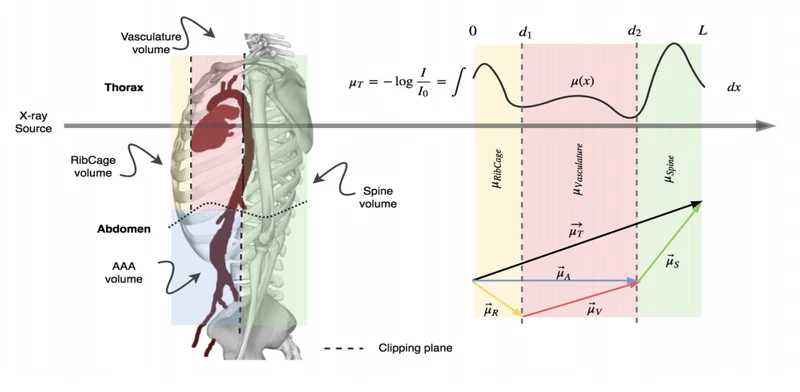
X-ray in-depth decomposition: Revealing the latent structures
Medical Image Computing and Computer Assisted Intervention – MICCAI 2017, Lecture Notes in Computer Science, 2017
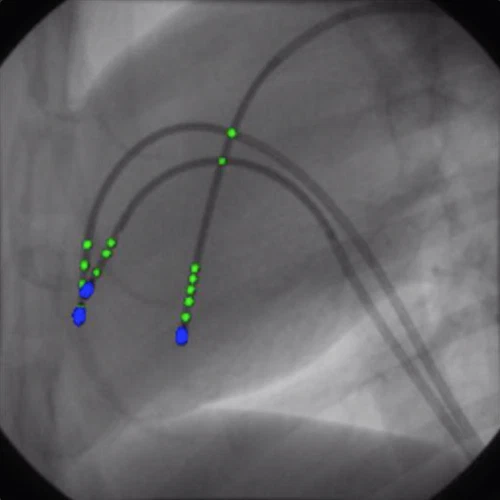
Cathnets: detection and single-view depth prediction of catheter electrodes
Medical Imaging and Augmented Reality (MIAR 2016), Lecture Notes in Computer Science, 2016
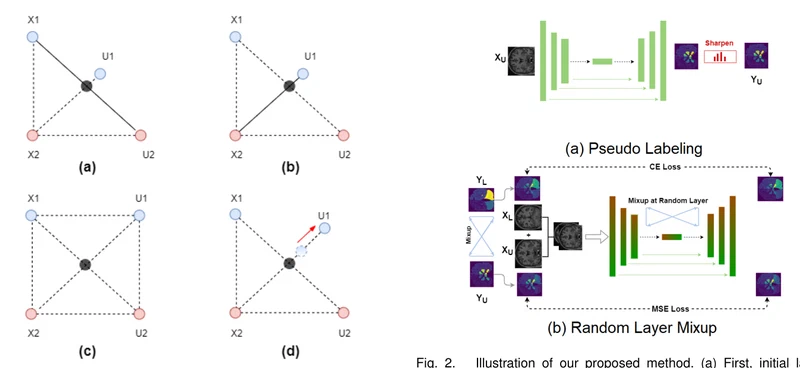
X-Ray PoseNet: 6 DoF pose estimation for mobile X-Ray devices
2017 IEEE Winter Conference on Applications of Computer Vision (WACV), 2017