Conference
CORE A
❝ citations
Scale-Space Autoencoders for Unsupervised Anomaly Segmentation in Brain MRI
Medical Image Computing and Computer Assisted Intervention – MICCAI 2020, Lecture Notes in Computer Science, 2020
Abstract
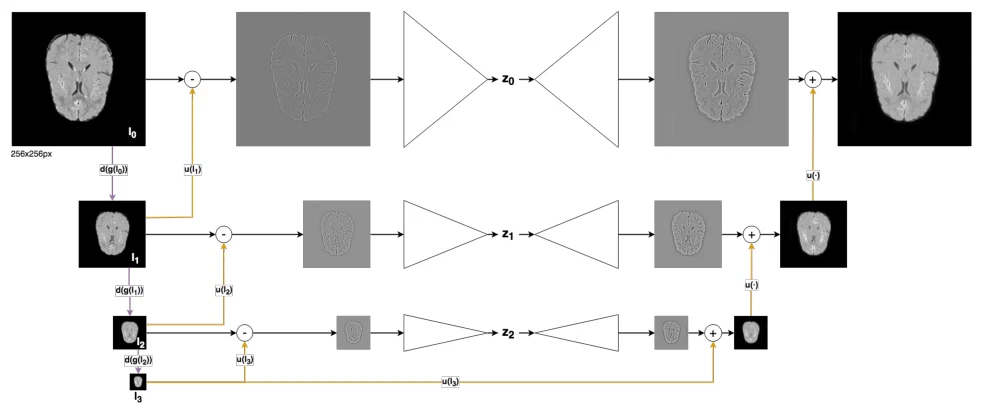
Brain pathologies can vary greatly in size and shape, ranging from few pixels (i.e. MS lesions) to large, space-occupying tumors. Recently proposed Autoencoder-based methods for unsupervised anomaly segmentation in brain MRI have shown promising performance, but face difficulties in modeling distributions with high fidelity, which is crucial for accurate delineation of particularly small lesions. Here, similar to these previous works, we model the distribution of healthy brain MRI to localize pathologies from erroneous reconstructions. However, to achieve improved reconstruction fidelity at higher resolutions, we learn to compress and reconstruct different frequency bands of healthy brain MRI using the laplacian pyramid. In a range of experiments comparing our method to different State-of-the-Art approaches on three different brain MR datasets with MS lesions and tumors, we show improved anomaly segmentation performance and the general capability to obtain much more crisp reconstructions of input data at native resolution. The modeling of the laplacian pyramid further enables the delineation and aggregation of lesions at multiple scales, which allows to effectively cope with different pathologies and lesion sizes using a single model.
Interactive explainer
Coming soon. An interactive Slidev walkthrough of this paper — with live, explorable figures — will appear here.
Authors: set
slidev: in this page's front matter to the deployed deck URL.Research themes


Cite (BibTeX)
@inproceedings{baur2020scale,
 author = {Baur, Christoph and Wiestler, Benedikt and Albarqouni, Shadi and Navab, Nassir},
 booktitle = {International Conference on Medical Image Computing and Computer-Assisted Intervention},
 organization = {Springer, Cham},
 pages = {552--561},
 title = {Scale-Space Autoencoders for Unsupervised Anomaly Segmentation in Brain MRI},
 year = {2020}
}