Book / Chapter
❝ citations
Capsule networks against medical imaging data challenges
Lecture notes in computer science, 2018
Abstract
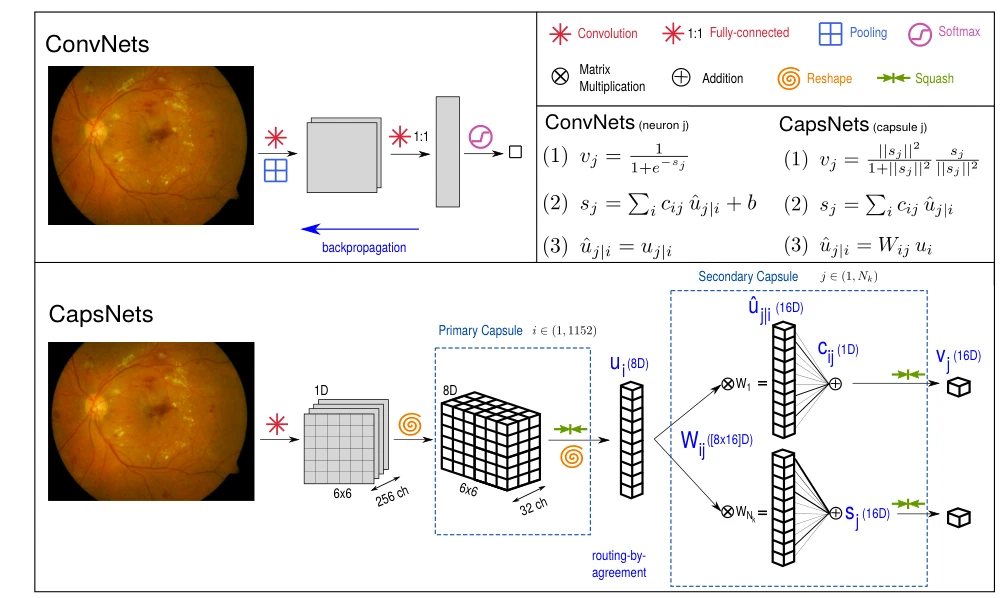
A key component to the success of deep learning is the availability of massive amounts of training data. Building and annotating large datasets for solving medical image classification problems is today a bottleneck for many applications. Recently, capsule networks were proposed to deal with shortcomings of Convolutional Neural Networks (ConvNets). In this work, we compare the behavior of capsule networks against ConvNets under typical datasets constraints of medical image analysis, namely, small amounts of annotated data and class-imbalance. We evaluate our experiments on MNIST, Fashion-MNIST and medical (histological and retina images) publicly available datasets. Our results suggest that capsule networks can be trained with less amount of data for the same or better performance and are more robust to an imbalanced class distribution, which makes our approach very promising for the medical imaging community.
Interactive explainer
Coming soon. An interactive Slidev walkthrough of this paper — with live, explorable figures — will appear here.
Authors: set
slidev: in this page's front matter to the deployed deck URL.Research themes
Keywords
Deep LearningMedical ImagingPowerful Representation
Lab authors


Cite (BibTeX)
@incollection{jimenez2018capsule,
 author = {Jiménez-Sánchez, Amelia and Albarqouni, Shadi and Mateus, Diana},
 booktitle = {Intravascular Imaging and Computer Assisted Stenting and Large-Scale Annotation of Biomedical Data and Expert Label Synthesis},
 pages = {150--160},
 publisher = {Springer, Cham},
 title = {Capsule networks against medical imaging data challenges},
 year = {2018}
}
Related publications
Generating highly realistic images of skin lesions with GANs
Lecture notes in computer science, 2018
Intraoperative stent segmentation in X-ray fluoroscopy for endovascular aortic repair
International journal of computer assisted radiology and surgery, 2018
Multiple device segmentation for fluoroscopic imaging using multi-task learning
Springer International Publishing, 2018
Weakly-supervised localization and classification of proximal femur fractures
arXiv preprint arXiv:1809.10692, 2018
Preprint
Medical Imaging