Workshop
❝ 5 citations
Sickle Cell Disease Severity Prediction from Percoll Gradient Images using Graph Convolutional Networks
MICCAI 2021 Workshops (DART and FAIR), LNCS 12968, 2021
Abstract
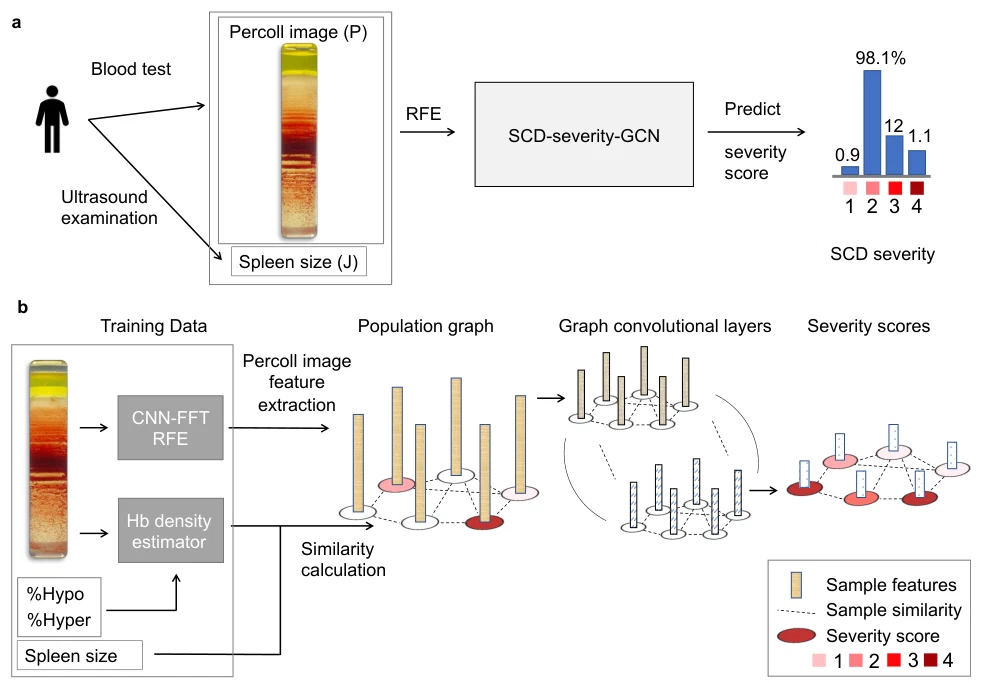
Sickle cell disease (SCD) is a severe genetic hemoglobin disorder that results in premature destruction of red blood cells. Assessment of the severity of the disease is a challenging task in clinical routine since the causes of broad variance in SCD manifestation despite the common genetic cause remain unclear. Identification of the biomarkers that would predict the severity grade is of importance for prognosis and assessment of responsiveness of patients to therapy. Detection of the changes in red blood cell (RBC) density through separation of Percoll density gradient could be such marker as it allows to resolve intercellular differences and follow the most damaged dense cells prone to destruction and vaso-occlusion. Quantification of the images obtained from the distribution of RBCs in Percoll gradient and interpretation of the obtained is an important prerequisite for establishment of this approach. Here, we propose a novel approach combining a graph convolutional network, a convolutional neural network, fast Fourier transform, and recursive feature elimination to predict the severity of SCD directly from a Percoll image. Two important but expensive laboratory blood test parameters measurements are used for training the graph convolutional network. To make the model independent from such tests during prediction, the two parameters are estimated by a neural network from the Percoll image directly. On a cohort of 216 subjects, we achieve a prediction performance that is only slightly below an approach where the groundtruth laboratory measurements are used. Our proposed method is the first computational approach for the difficult task of SCD severity prediction. The two-step approach relies solely on inexpensive and simple blood analysis tools and can have a significant impact on the patients’ survival in underdeveloped countries where access to medical instruments and doctors is limited
Interactive explainer
Auto-generated. This explainer was generated automatically with Claude (Anthropic) from the published paper. It simplifies the method and may contain errors — for a correct understanding, and for all results and numbers, please refer to the published paper (publisher version).
Research themes
Research areas
Funded by


Cite (BibTeX)
@incollection{sadafi2021sickle,
 author = {Sadafi, Ario and Makhro, Asya and Livshits, Leonid and Navab, Nassir and Bogdanova, Anna and Albarqouni, Shadi and Marr, Carsten},
 booktitle = {Domain Adaptation and Representation Transfer, and Affordable Healthcare and AI for Resource Diverse Global Health},
 pages = {216--225},
 publisher = {Springer, Cham},
 title = {Sickle Cell Disease Severity Prediction from Percoll Gradient Images using Graph Convolutional Networks},
 year = {2021}
}