Conference
❝ citations
Benefit of dual energy CT for lesion localization and classification with convolutional neural networks
Medical Imaging 2020: Physics of Medical Imaging, 2020
Abstract
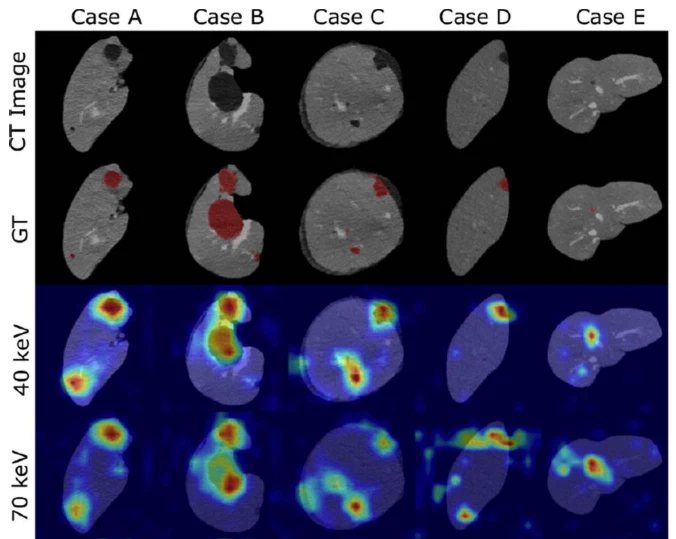
Dual Energy CT is a modern imaging technique that is utilized in clinical practice to acquire spectral information for various diagnostic purposes including the identification, classification, and characterization of different liver lesions. It provides additional information that, when compared to the information available from conventional CT datasets, has the potential to benefit existing computer vision techniques by improving their accuracy and reliability. In order to evaluate the additional value of spectral versus conventional datasets when being used as input for machine learning algorithms, we implemented a weakly-supervised Convolutional Neural Network (CNN) that learns liver lesion localization and classification without pixel-level ground truth annotations. We evaluated the lesion classification (healthy, cyst, hypodense metastasis) and localization performance of the network for various conventional and spectral input datasets obtained from the same CT scan. The best results for lesion localization were found for the spectral datasets with distances of 8.22 ± 10.72 mm, 8.78 ± 15.21 mm and 8.29 ± 12.97 mm for iodine maps, 40 keV and 70 keV virtual mono-energetic images, respectively, while lesion localization distances of 10.58 ± 17.65 mm were measured for the conventional dataset. In addition, the 40 keV virtual mono-energetic datasets achieved the highest overall lesion classification accuracy of 0.899 compared to 0.854 measured for the conventional datasets. The enhanced localization and classification results that we observed for spectral CT data demonstrates that combining machine-learning technology with spectral CT information may improve the clinical workflow as well as the diagnostic accuracy.
Interactive explainer
Coming soon. An interactive Slidev walkthrough of this paper — with live, explorable figures — will appear here.
Authors: set
slidev: in this page's front matter to the deployed deck URL.Research themes
Keywords
Deep LearningMedical ImagingRadiologyWeakly-Supervised Learning
Lab authors

Cite (BibTeX)
@inproceedings{shapira2020benefit,
 author = {Shapira, Nadav and Fokuhl, Julia and Schultheiß, Manuel and Beck, Stefanie and Kopp, Felix K and Pfeiffer, Daniela and Dangelmaier, Julia and Pahn, Gregor and Sauter, Andreas P and Renger, Bernhard and others},
 booktitle = {Medical Imaging 2020: Physics of Medical Imaging},
 organization = {International Society for Optics and Photonics},
 pages = {113121Q},
 title = {Benefit of dual energy CT for lesion localization and classification with convolutional neural networks},
 volume = {11312},
 year = {2020}
}
Related publications
Liver lesion localisation and classification with convolutional neural networks: a comparison between conventional and spectral computed tomography
Biomedical Physics & Engineering Express, 2020
Towards an Interactive and Interpretable CAD System to Support Proximal Femur Fracture Classification
arXiv preprint arXiv:1902.01338, 2019
Weakly-supervised localization and classification of proximal femur fractures
arXiv preprint arXiv:1809.10692, 2018
Preprint
Medical Imaging
Image-to-Images Translation for Multi-Task Organ Segmentation and Bone Suppression in Chest X-Ray Radiography
IEEE Transactions on Medical Imaging, 2020