3 December 2026 · BonnJour, Baunscheidtstr. 17, 53113 Bonn, Germany
MISTAI Computational Pathology Workshop
MISTAI Computational Pathology Workshop — AI for Muscle-Invasive Bladder Cancer
 Shadi Albarqouni
 Nina Bondarenko
 Alina Bilokha
 Dmytro Sutyrin
 Olexandr Bondarenko
 Jiajun Zeng
 Adea Nesturi
 David D. Gaviria
 Martina Herwig-Carl
 Azar Kazemi
 Ashkan Shakarami
 Tingying Peng
 Konstanty Korski
 Sanket KacholeMedical ImagingResponsible AIMISTAIINTERACT-CMIL: Interpretable …
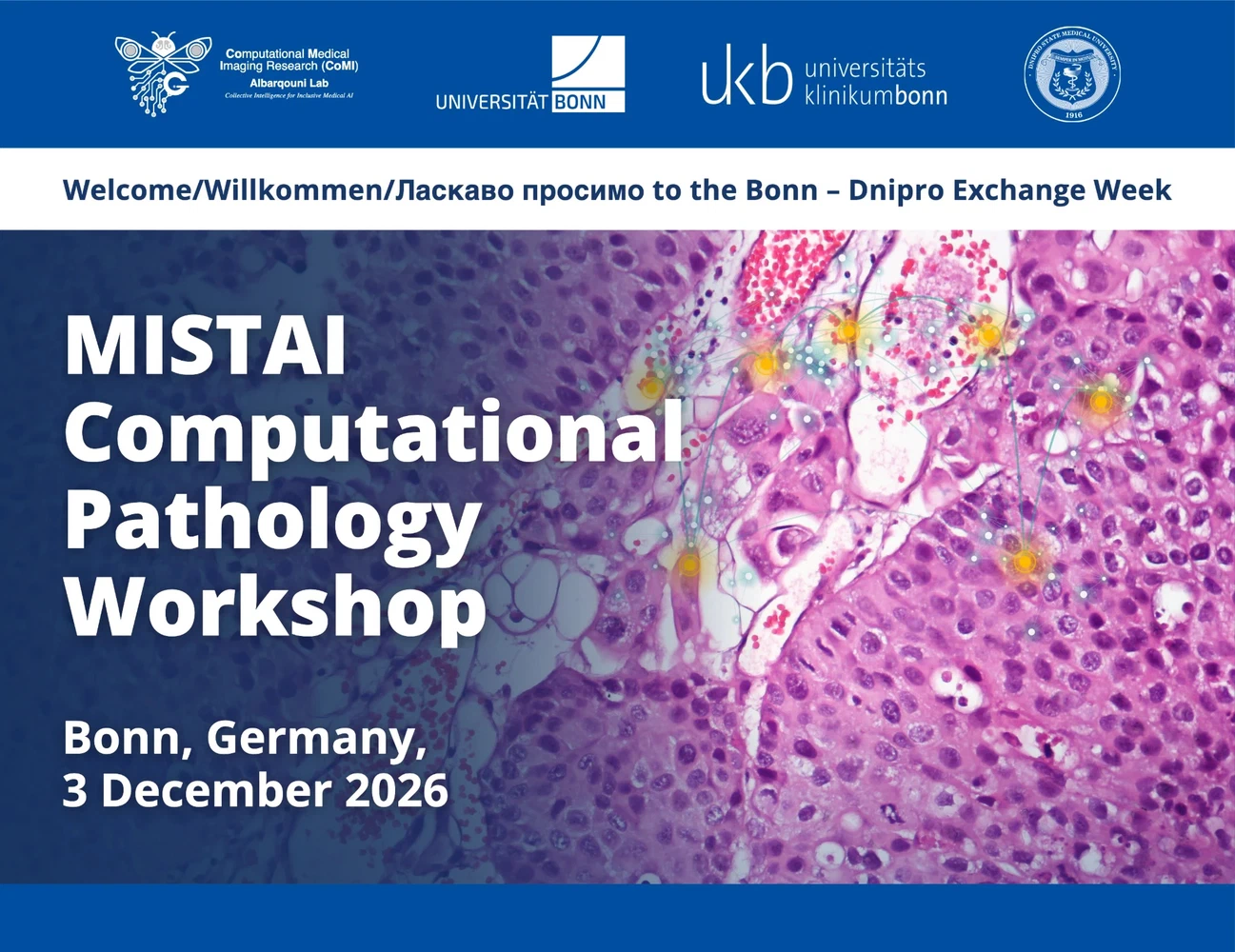
On 3 December 2026 we host a full-day Computational Pathology Workshop in Bonn as part of MISTAI — Medical Intelligence & Skills Training in AI, our cooperation with Dnipro State Medical University (DSMU) in Ukraine, funded by the Ministry of Culture and Science of North Rhine-Westphalia (MKW NRW). The workshop takes place during the one-week exchange visit of the DSMU team, which also includes a round table on collaboration projects and EU/DFG grant strategy (30 November), the Science Summit NRW–Ukraine in Essen (1 December), the Ukraine Science Days at Ruhr University Bochum (2 December) and lab tours in Bonn (4 December).
It brings together pathologists, clinicians and AI researchers around one question: how can AI and digital pathology keep diagnostics, research and teaching going when physical infrastructure is disrupted? Two keynotes open the day and a third, by Sanket Kachole (Indiana University School of Medicine), closes it, on moving from foundation models to multimodal clinical intelligence beyond the slide. The opening keynotes are by Tingying Peng (Helmholtz AI / TUM) on multimodal foundation models for computational pathology, and by Konstanty Korski (Roche Diagnostics) on computational co-intelligence in diagnostic pathology. They are followed by talks on the shared Bonn–Dnipro data platform for muscle-invasive bladder cancer, AI-assisted grading of conjunctival melanocytic lesions in QuPath, and innovations for molecular diagnostics. In the afternoon, young researchers from Bonn and Dnipro present their work in spotlight talks — including results from fine-tuning pathology foundation models and live demos in QuPath (MISTAI and INTERACT-CMIL) — followed by the new Computational Pathology teaching module for DSMU.
The programme below is tentative and will be updated as speakers are confirmed. Participation is free; please register by 23 November 2026. Places are limited and allocated in order of registration; we’ll confirm by email. Coffee and a light lunch will be offered to confirmed participants. A certificate of attendance will be issued to all attended participants.



Programme Tentative — subject to change
Monday, 30 November 2026 — Partner discussions
- Round tableRound table: potential collaboration projects and next stepsMISTAI partners
- Internal review of the exchange week and EU/DFG grant strategy
Tuesday, 1 December 2026 — Science Summit NRW–Ukraine (Essen)
Wednesday, 2 December 2026 — Ukraine Science Days 2026 — From Research to Impact (Bochum)
- Ukraine Science Days 2026: Research Funding, Innovation and Scientific Partnerships
Thursday, 3 December 2026 — Computational Pathology Workshop
- Registration
- Welcome and opening remarks — introduction to MISTAIShadi AlbarqouniNina Bondarenko
- KeynoteFrom Slides to Biological Insights: Multimodal Foundation Models for Computational PathologyTingying Peng
Abstract
Recent advances in foundation models are transforming computational pathology, moving beyond individual prediction tasks toward more generalizable and biologically meaningful representations. In this talk, I will discuss how multimodal foundation models can connect histopathology images with complementary sources of biological and clinical information.
Drawing on our work in computational pathology, I will highlight TITAN, a multimodal whole-slide foundation model, and HistoGPT, a vision-language approach for generating dermatopathology reports from histological images. I will also introduce Phoenix, our pan-cancer framework for virtual spatial transcriptomics, which extends image-based analysis toward spatial molecular characterization.
Together, these examples illustrate opportunities to develop more flexible and data-efficient pathology AI systems. I will discuss remaining challenges, including adaptation to new domains with limited annotated data, generalization across institutions, and rigorous biological and clinical validation. I will also touch on how such models could support pathology research, diagnostics, and education in settings where access to specialist expertise and infrastructure is constrained.
- KeynoteComputational Co-Intelligence: Closing the Gap Between Technology and Patients’ NeedsKonstanty Korski
Abstract
Modern oncology faces a widening operational gap: the global pathologist workforce is short-staffed, pathologist supply in the USA is projected to decline by about 5% while diagnostic demand rises by more than 13% through 2037, and a “complexity multiplier” means that a single case now needs ever denser IHC panels, molecular assays and genomic data. Patients, meanwhile, expect fast and precise diagnostics that guide the best treatment, without administrative or diagnostic delays.
To bridge this shortfall, diagnostic medicine must move beyond fragmented workflows in which pathologists spend only around 35% of their time on direct diagnosis. Pathologists supported by computational tools play a critical role in translating tissue images into tailored clinical decisions. Through Computational Co-Intelligence (human clinical judgement, contextual reasoning and ethics combined with computational speed, scale and pattern recognition), deep-learning algorithms can prescreen routine H&E slides for actionable biomarkers such as EGFR mutations and MSI-High, and generate virtual stains, accelerating precision treatment planning.
Algorithm development alone is not enough: there is an urgent need to find the most effective ways for these advances to reach clinicians and their patients. That requires intelligent data-orchestration platforms that break down software silos across laboratory and clinical systems. Paired with interdisciplinary trial leadership, professional-society guidelines and clear regulatory guardrails, integrated computational workflows can deliver high-precision diagnostic insights safely and reliably at scale.
- Coffee break
- Muscle-Invasive Bladder Cancer: The Dnipro Cohort, Digitisation, and Joint AnnotationNina Bondarenko
- QuPath application for AI-assisted grading of conjunctival melanocytic intraepithelial lesions (CMIL)Martina Herwig-CarlAshkan Shakarami
- Chat with your DNA — innovations for molecular diagnostics
 Verena Tischler
- Lunch break and group photo
- SpotlightEntering the World of Computational Pathology: Lessons from Muscle-Invasive Bladder Cancer AnnotationAlina Bilokha
- SpotlightAre Future Ukrainian Doctors Ready for AI? Perspectives on Education, Research, and Clinical PracticeDmytro Sutyrin
- SpotlightFine-tuning pathology foundation models across Bonn and Dnipro — with a live demo in QuPathJiajun Zeng
- SpotlightFewer labels, unseen classes: label-efficient federated learning for open-set pathology with PromptGate and FIDAL (working title)Adea NesturiDavid D. Gaviria
- SpotlightFrom Foundation Models to Ensembles: AI for Barrett’s EsophagusAzar Kazemi
- The New Computational Pathology Teaching Module for Dnipro State Medical UniversityOlexandr Bondarenko (remotely)Nina BondarenkoShadi Albarqouni
- KeynoteBeyond the Slide: From Foundation Models to Multimodal Clinical IntelligenceSanket Kachole (remotely)
- Closing remarksShadi AlbarqouniNina Bondarenko
Friday, 4 December 2026 — Lab tours
- Lab tour: Ophthalmopathology Lab (AG Herwig-Carl), Department of Ophthalmology📍 Buildings A 04/A 05 · for navigation: Ernst-Abbe-Straße 2, 53127 Bonn · campus map, square AMartina Herwig-Carl
- Lab tour: Translational Lung and Tumour Pathology Lab (AG Tischler), Institute of Pathology📍 Building 62 · for navigation: Venusberg-Campus 1, 53127 Bonn · campus map, square CVerena Tischler