BIGPICTURE
BigPicture Project
European IMI2 consortium building the largest platform of digital pathology images for AI (2021–2027). We took part at TU Munich, contributing federated learning, until 2020.
Abstract
About BIGPICTURE
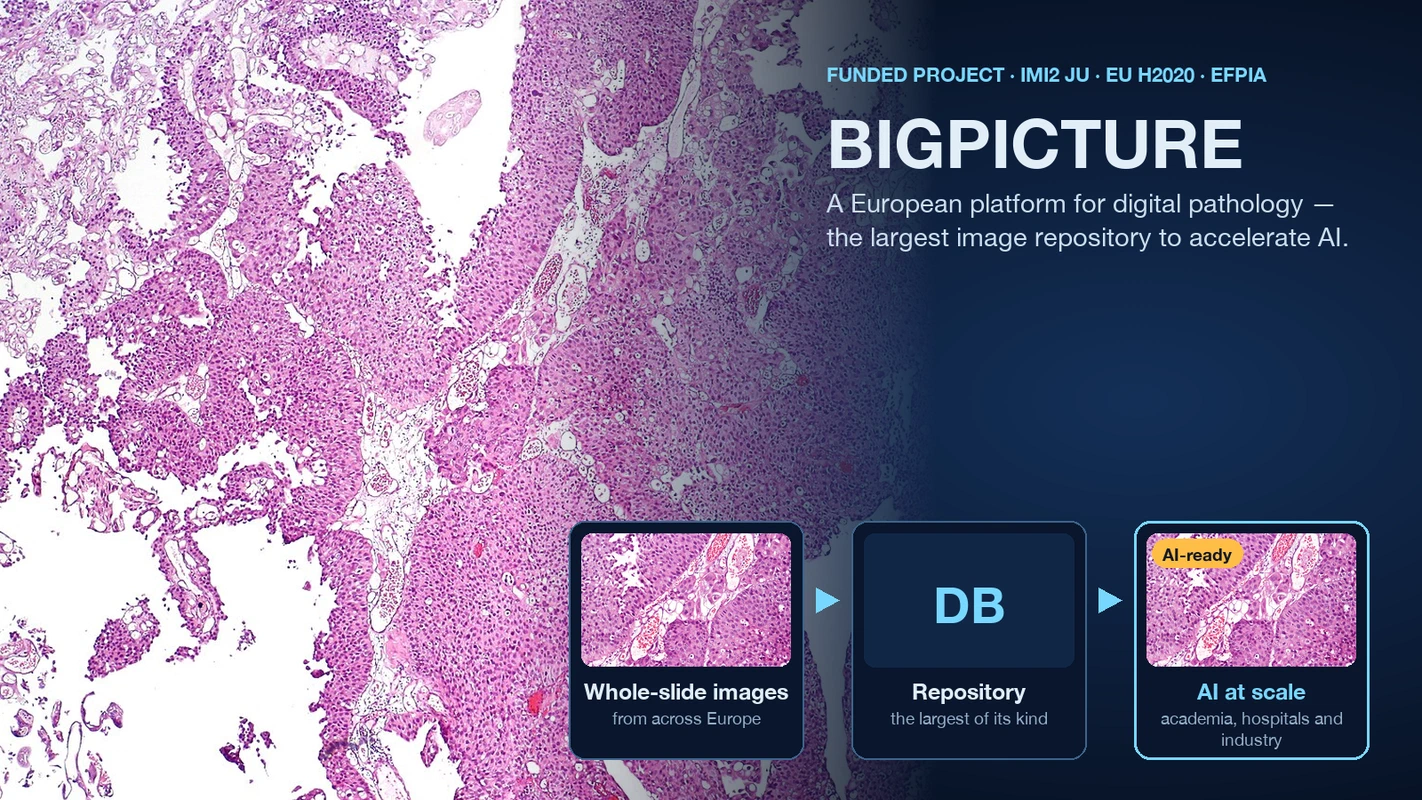
BIGPICTURE is a six-year public–private consortium of the Innovative Medicines Initiative that started in 2021 to build a European repository of digital pathology slides together with the AI tools that use them. Pathology — the microscopic examination of tissue — underpins the diagnosis of cancer and many other diseases and the safety assessment of new drugs, yet it still relies largely on qualitative assessment. Digitised slides make AI support possible, but robust models need very large, well-annotated collections that are hard to share because of their size and the confidentiality of the medical data behind them. BIGPICTURE therefore set out to create an ethical, GDPR-compliant and quality-controlled platform where data and algorithms coexist, starting from about three million slides of human and animal tissue, and connecting pathologists, researchers, AI developers, patients and industry (consortium announcement, 2021).
Our participation (TU Munich, until 2020)
Our involvement was limited to the period at TU Munich and ended in 2020, when Shadi Albarqouni moved from Munich; we are not part of the consortium since. In this project, Prof. Nassir Navab, and Dr. Shadi Albarqouni from TU Munich, together with Owkin will be leading and contributing to the development of Federated Deep Learning algorithms leveraging massive amounts of data, distributed in multiple sources, in a privacy-preserved fashion. This will enable deep learning models to be trained using sensitive data that cannot be made publicly available due to GPDR or sensitivity, e.g. rare diseases. Please visit the website of BIGPICTURE for further details.
Funding
This project has received funding from the Innovative Medicines Initiative 2 Joint Undertaking (IMI2 JU) under grant agreement No 945358. The JU receives support from the European Union’s Horizon 2020 research and innovation programme and EFPIA.