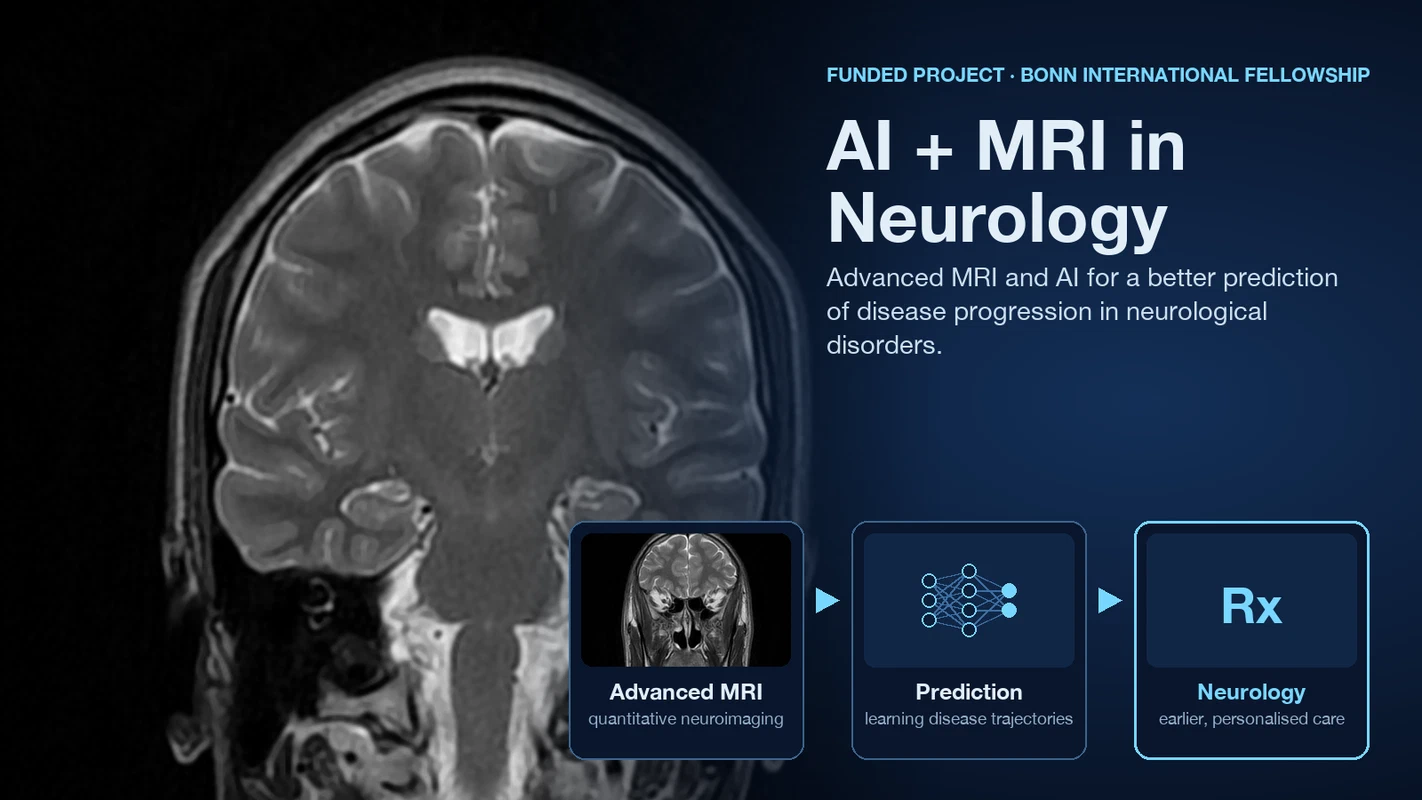
Application of AI and Advanced MRI for a Better Prediction of Disease Progression in Neurological Disorders
Bonn International Fellowship (2025–2026) with Dr. Ceren Tozlu (Weill Cornell Medicine) — AI, advanced neuroimaging and federated learning to detect lesions and predict disease progression in multiple sclerosis, linking our lab with the AI working group of the North American Imaging in MS Cooperative.
Abstract
This Bonn International Fellowship brings Dr. Ceren Tozlu (Weill Cornell Medicine, New York) to the Albarqouni Lab to strengthen our collaboration with the Artificial Intelligence and Machine Learning (AIMS) working group of the North American Imaging in MS (NAIMS) Cooperative, where Dr. Tozlu serves on the steering committee.
Together we develop joint projects that use AI and advanced neuroimaging to detect lesions and predict disease progression in neurological disorders, with a focus on multiple sclerosis (MS).
Why federated learning
Data-sharing rules in the United States, as in Europe, make it hard to pool MRI data from many hospitals. Federated learning trains models across sites without moving patient data, so larger and more diverse cohorts can be used. That, in turn, can improve our understanding of the neurobiological mechanisms of MS and support more accurate prognoses, better treatment decisions and the development of new therapies.
Our role
The Albarqouni Lab builds the federated learning infrastructure that connects researchers in the US and Europe. It draws on our work on federated learning in healthcare, including Federated disentangled representation learning for unsupervised brain anomaly detection (Nature Machine Intelligence, 2022), and on the MICCAI workshop series on distributed, collaborative and federated learning that we have co-organised every year since DCL 2020, continuing with DeCaF.
Prof. Albarqouni presented this line of work in an invited talk at the NAIMS Cooperative in September 2024.