Rare Blood Disorders
Explainable AI for rare blood disorders
Collaboration with Carsten Marr (Helmholtz Munich) on explainable deep learning for diagnosing rare anaemias and blood cell disorders — attention-based and anomaly-aware multiple instance learning on single-cell images, Percoll-gradient analysis for hereditary haemolytic anaemias and sickle cell disease, and cross-domain features for white blood cells.
Abstract
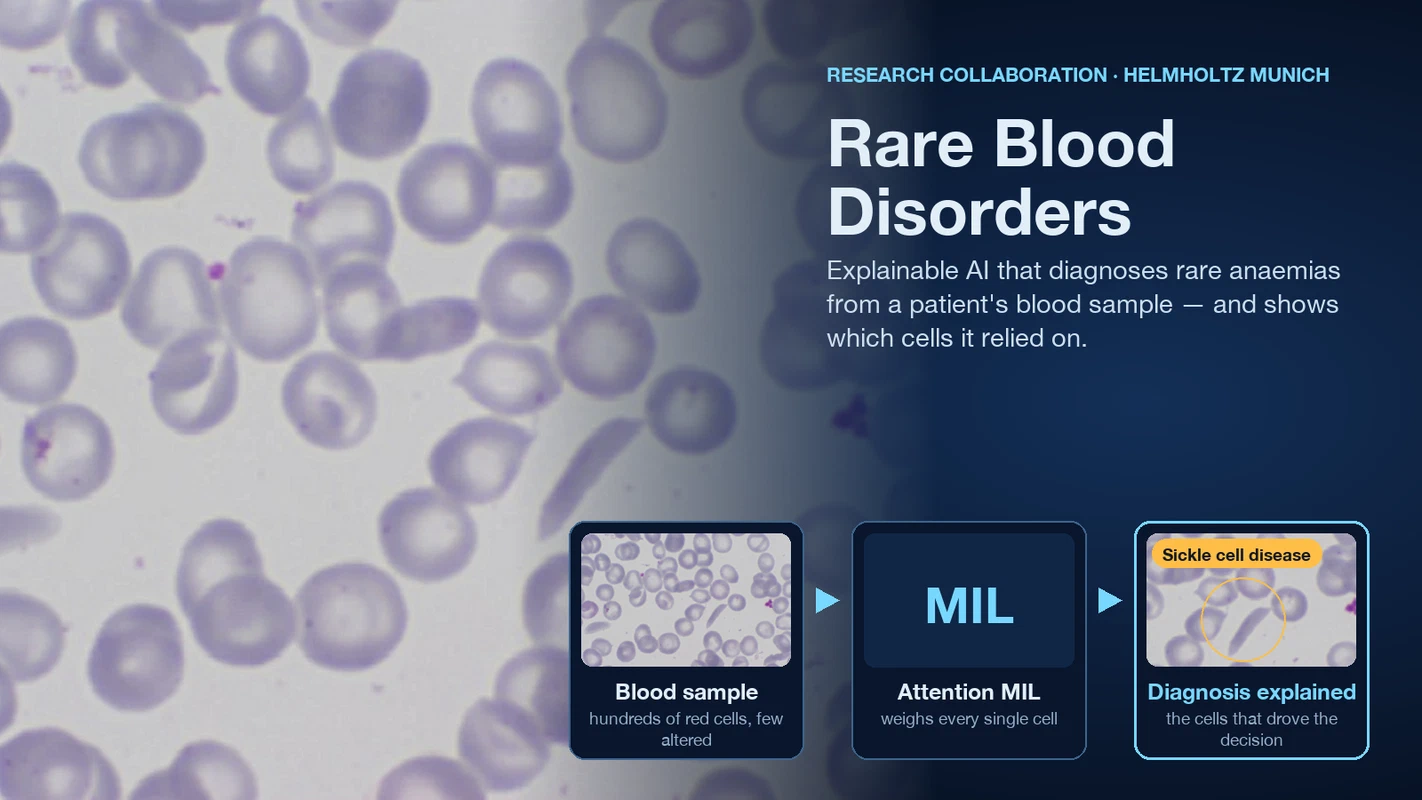
Rare anaemias such as hereditary spherocytosis or sickle cell disease are diagnosed from blood samples in which only a fraction of the red blood cells is visibly altered. Labelling every cell is laborious and subjective, specialised genetic tests are expensive and unavailable in most labs, and for rare diseases there are simply very few patients to learn from. Clinicians also need to see why a model reaches a diagnosis before they can trust it. Together with Carsten Marr’s group at Helmholtz Munich and haematology partners (Anna Bogdanova, University of Zurich), we developed explainable methods that diagnose at the level of the patient while pointing to the individual cells that matter.
What we did
- Attention-based multiple instance learning. Each blood sample is treated as a bag of single red blood cells detected with an R-CNN; an attention-based MIL model classifies the patient into one of four blood cell disorders, and the attention weights show how much each cell contributed — improving both accuracy and interpretability for the haematologist (MICCAI 2020).
- Percoll density gradients as an affordable biomarker. Centrifuging a patient’s blood through a Percoll gradient separates red cells by density. Combining CNN features with Fourier spectral features of the gradient images classified hereditary haemolytic anaemias with an average F1-score of 88% (ISBI 2021), and graph convolutional networks on the gradient profiles predicted sickle cell disease severity (MICCAI DART/FAIR 2021).
- Robustness across labs. A cross-domain adapted autoencoder extracts white blood cell features in an unsupervised way, so that classifiers trained on one dataset transfer to smears from other sites, stains and microscopes (MICCAI 2022).
- Anomaly-aware MIL for very rare disorders. By using healthy cells from negative bags as a reference, an interpretable pooling method raises the contribution of anomalous cells and outperforms attention-based MIL on rare anaemia classification with few training samples (MICCAI 2022, with Salome Kazeminia).
Our role
Co-supervision of Ario Sadafi’s PhD (TU Munich and Helmholtz Munich, with Carsten Marr and Nassir Navab), started at TU Munich CAMP and continued at Helmholtz AI, and contributions to the work of Salome Kazeminia and Raheleh Salehi in Carsten Marr’s group.
Perspective
The project showed that patient-level labels are enough to train cell-level explanations, a principle we now apply to weakly supervised learning in computational pathology and other rare-disease settings.
Partner institutions




Publications 7
Digital staining of white blood cells with confidence estimation
IEEE Transactions on Medical Imaging, 2023
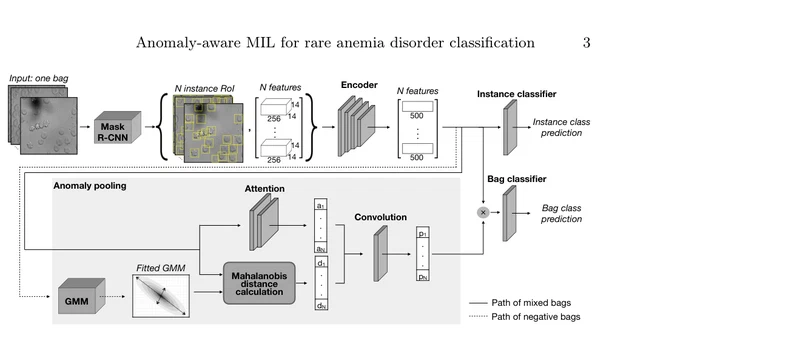
Anomaly-aware multiple instance learning for rare anemia disorder classification
Medical Image Computing and Computer Assisted Intervention – MICCAI 2022, Lecture Notes in Computer Science, 2022
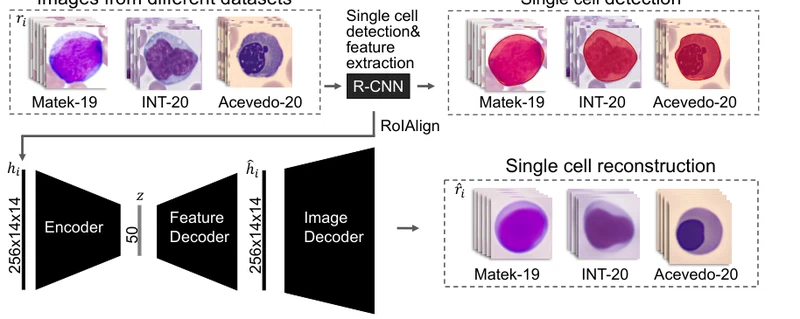
Unsupervised Cross-Domain Feature Extraction for Single Blood Cell Image Classification
Medical Image Computing and Computer Assisted Intervention – MICCAI 2022, Lecture Notes in Computer Science, 2022
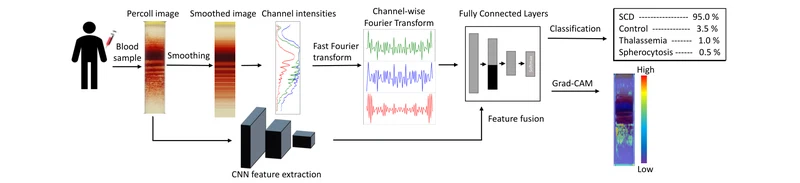
Fourier Transform of Percoll Gradients Boosts CNN Classification of Hereditary Hemolytic Anemias
2021 IEEE 18th International Symposium on Biomedical Imaging (ISBI), 2021
Multi-task multi-domain learning for digital staining and classification of leukocytes
IEEE Transactions on Medical Imaging, 2021
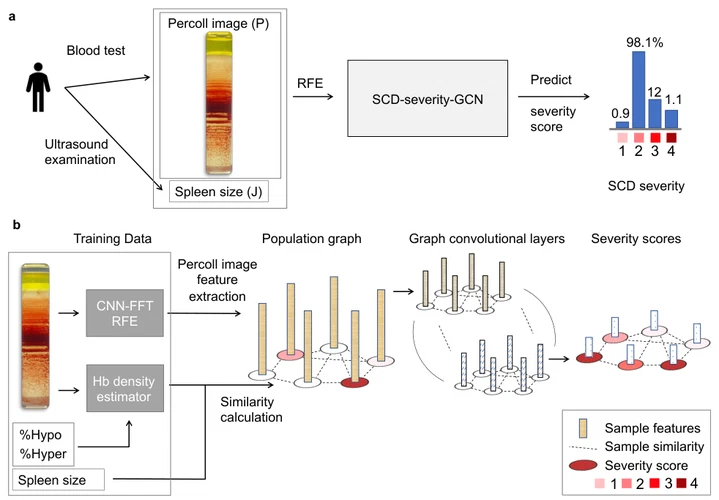
Sickle Cell Disease Severity Prediction from Percoll Gradient Images using Graph Convolutional Networks
MICCAI 2021 Workshops (DART and FAIR), LNCS 12968, 2021
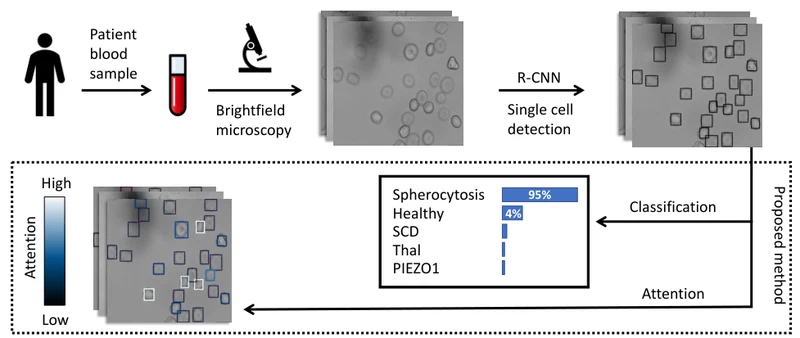
Attention Based Multiple Instance Learning for Classification of Blood Cell Disorders
International Conference on Medical Image Computing and Computer-Assisted Intervention, 2020