deepc Head CT
Unsupervised anomaly detection in full-head CT for emergency triage
Collaboration with the Munich radiology-AI company deepc on unsupervised anomaly detection in volumetric head CT — prioritising emergency scans for any pathology, fractures included, without labelled examples of every disease.
Abstract
In the emergency room, head CT scans must be read and prioritised quickly — and the findings range from bleeds to fractures. Supervised detectors need labelled examples of every pathology; unsupervised anomaly detection (UAD) instead learns what normal anatomy looks like and flags everything else, an inexpensive way to bring triage to the clinical workflow. Most UAD work, however, addressed 2D slices of brain MRI rather than volumetric CT.
What we did
- UAD for volumetric head CT. We compared two widely used reconstruction-based baselines on full 3D head CT, and improved their reconstruction quality with two recent computer-vision contributions — raising anomaly-detection AUROC from 0.70 to 0.77 for one baseline.
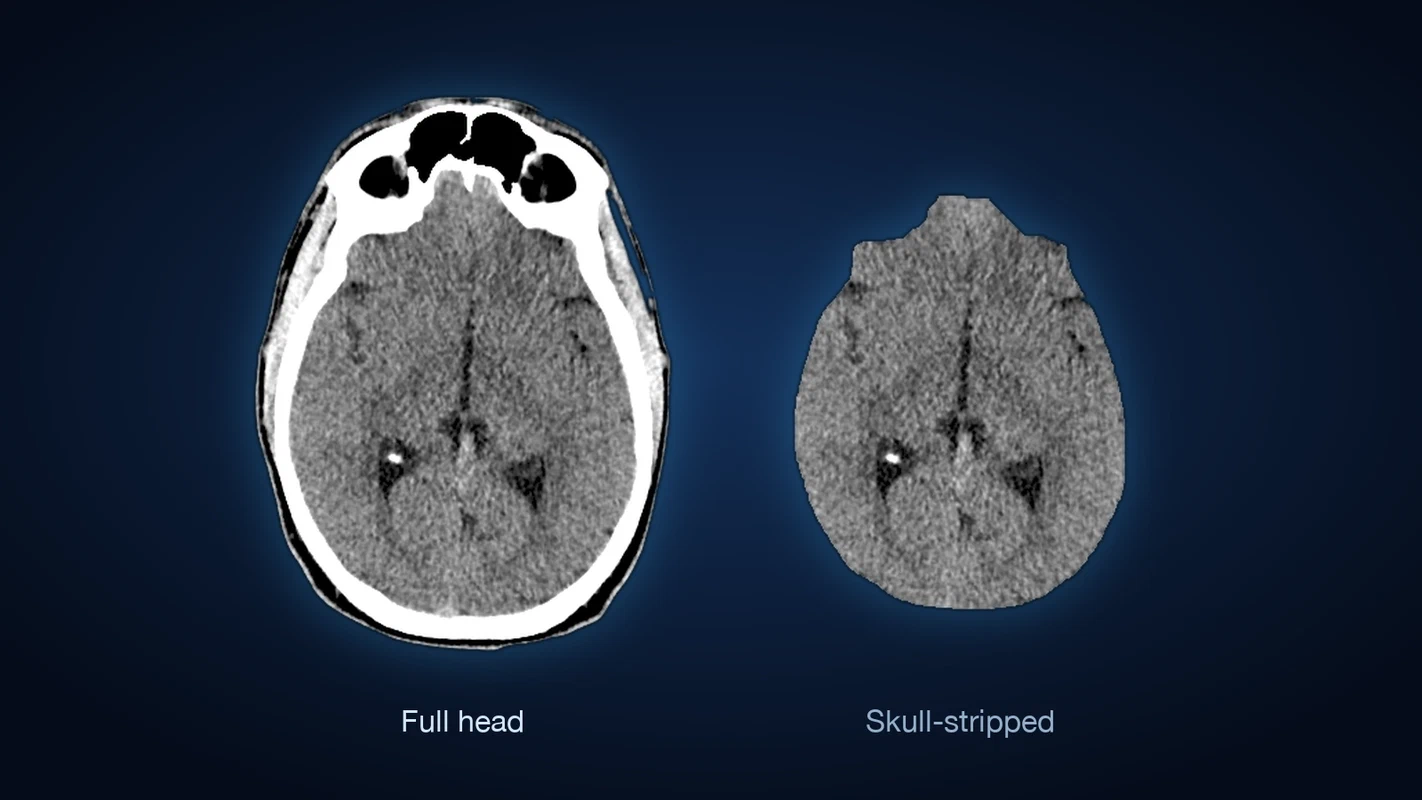
- Keep the skull. Testing on skull-stripped and unstripped volumes showed that leaving the skull in lets the model detect fractures too — to our knowledge the first comparison of this kind.
- Open labels and code. Supplementary labels for the public CQ500 head-CT dataset and the code were released to support further research.
Our role
Academic lead and supervision, together with Daniel Rueckert (TU Munich) and Mehmet Yigitsoy and Abhijeet Parida (deepc GmbH).
Partner institutions







Publications 1
CTFSH: Full Head CT Anomaly Detection with Unsupervised Learning
OpenReview preprint (submitted to MIDL 2022), 2022