Bias-aware foundation models for equitable breast cancer screening
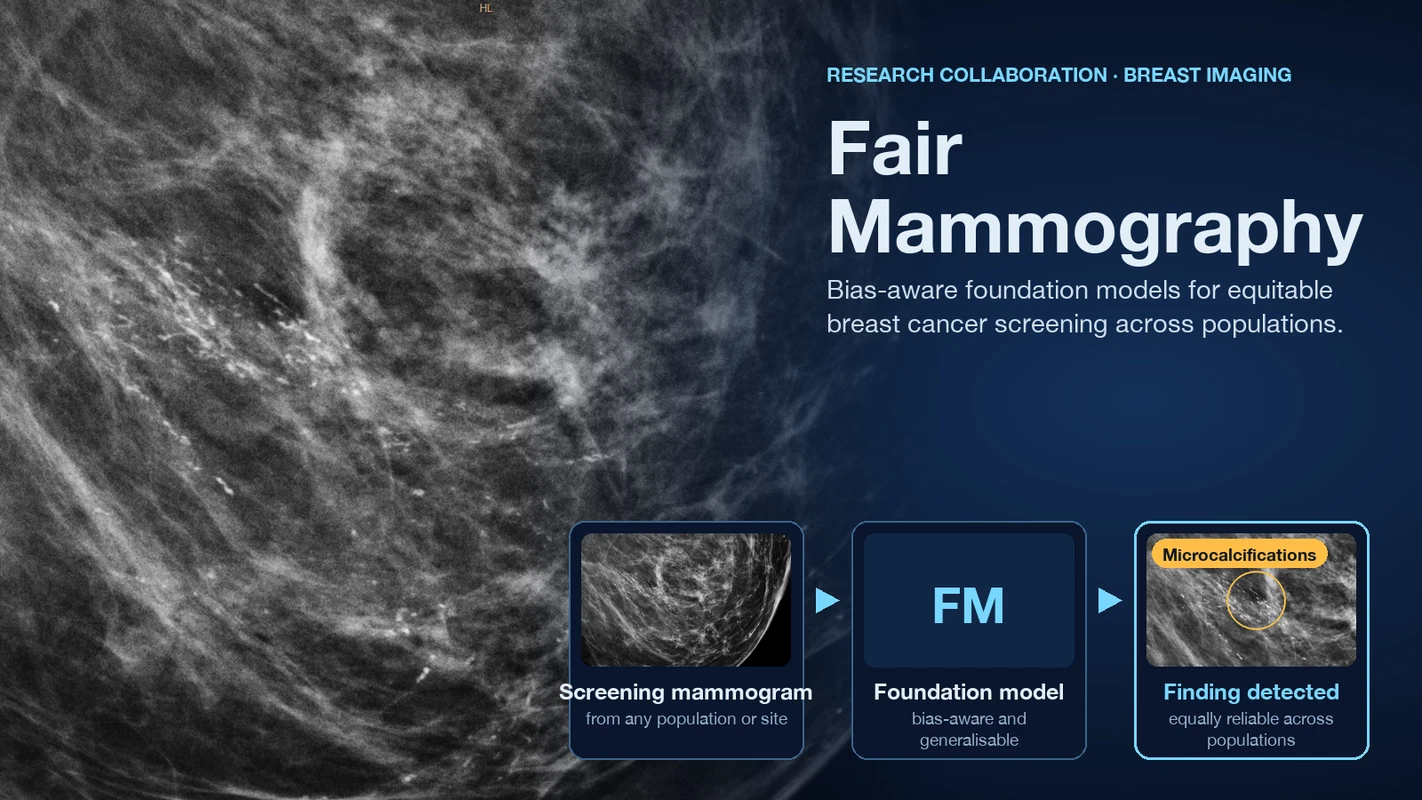
This project addresses fairness and generalization challenges of foundation models for breast mammography, where AI systems trained predominantly on data from high-income countries often underperform in underrepresented populations.
Abstract
This project addresses fairness and generalization challenges of foundation models for breast mammography, where AI systems trained predominantly on data from high-income countries often underperform in underrepresented populations. Together with international clinical partners, we assembled and analyzed a heterogeneous collection of mammography datasets from Europe, North America, the Middle East, and Asia, including a biopsy-confirmed in-house cohort of approximately 1,500 patients from Lebanon. Methodologically, we conducted a systematic evaluation of foundation models under cross-dataset shift and demonstrated that naïve dataset aggregation improves average performance but does not eliminate subgroup-specific biases. Fairness-aware optimization strategies substantially reduced performance disparities across age groups, breast density categories, and geographic regions while maintaining competitive diagnostic accuracy.
Perspective
The collaboration constitutes an ongoing international research effort at the intersection of medical imaging, fairness-aware AI, and global health. Building on current results, the project is being expanded to additional clinical partners in Palestine and Egypt, supported by the Global One Health Research Academy (GLOHRA), and is planned to scale further through the submitted EU Horizon Europe project SHE-Scan, contingent on funding.
Partner institutions


Publications 5

Reducing Clinician Annotation Fatigue in Open-Set Federated Learning: A Client-Adaptive Vision-Language Gatekeeper
Journal of the American College of Radiology, 2026
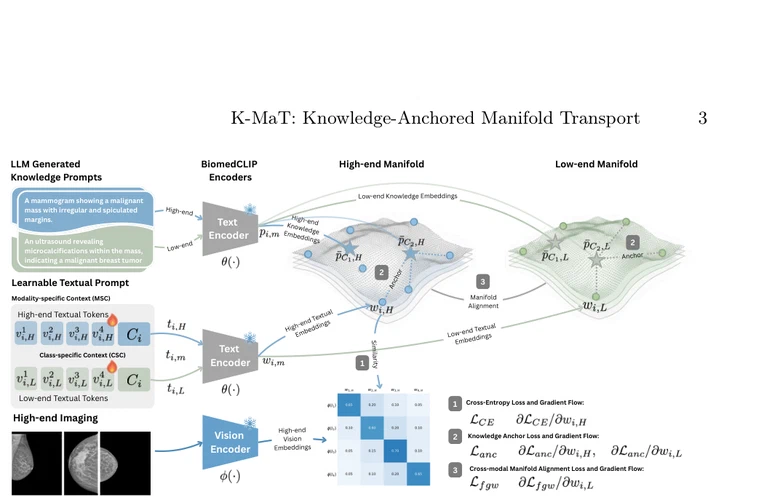
K-MaT: Knowledge-Anchored Manifold Transport for Cross-Modal Prompt Learning in Medical Imaging
Medical Image Computing and Computer Assisted Intervention – MICCAI 2026, Lecture Notes in Computer Science, 2026

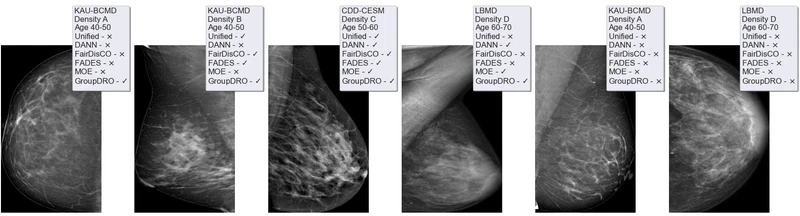
Bias and generalizability of foundation models across datasets in breast mammography
International conference on medical image computing and computer-assisted intervention, 2025
Two-Steps Approach for Breast Cancer Detection and Classification Using Convolutional Neural Networks.
International Journal on Engineering Applications, 2024