Pomegranate AI
AI for predicting the technological and phenolic maturity of pomegranates in Lebanon
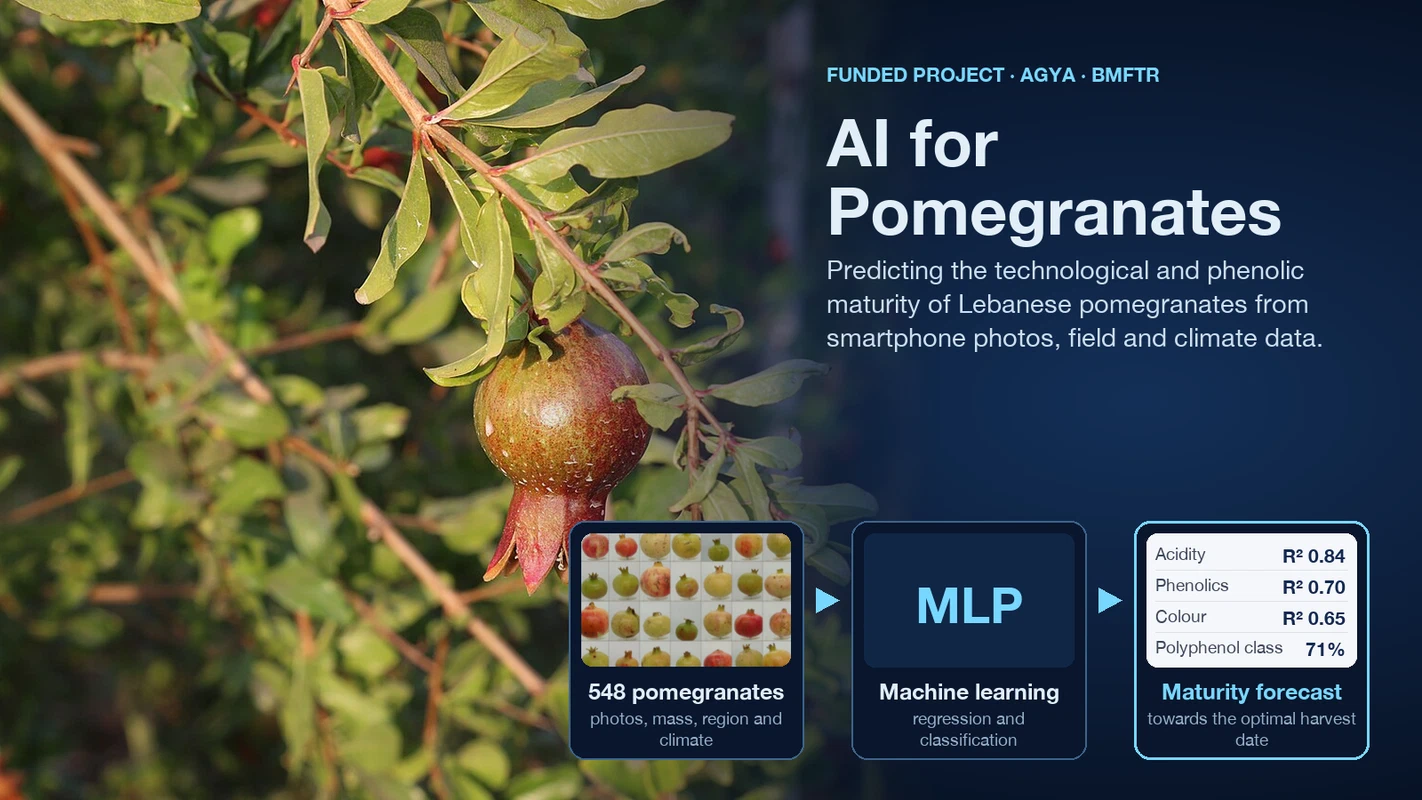
AGYA interdisciplinary project with Beirut Arab University that uses machine learning on smartphone photographs, physical, geographical and climate data to predict the technological and phenolic maturity of Lebanese pomegranates — and with it the optimal harvest date.
Abstract
Pomegranates are one of Lebanon’s important fruit crops, and the date on which they are harvested decides both their health value — their content of antioxidant polyphenols — and their market value. Farmers usually harvest on experience or by the calendar, without accounting for how strongly the climate and the growing region shape fruit maturity, and the laboratory measurements that would tell them are slow and need equipment most farms do not have.
Bringing together food science at Beirut Arab University (Nada El Darra) and AI at the University of Bonn, this interdisciplinary project of the Arab-German Young Academy of Sciences and Humanities (AGYA) asked whether simple, cheap measurements can predict the quality of the fruit before it is harvested.
What we did
- A unique field dataset. Over three months of the 2023 season (September–November), 548 sweet pomegranates were harvested from three regions of Lebanon — Hasbaya, El Jahliye and Rachiine. Each fruit was photographed with a smartphone under controlled conditions and weighed and measured, and its juice was analysed in the laboratory for total soluble solids, titratable acidity, maturity index, polyphenol content and colour intensity. Climate data (temperature, solar radiation, humidity, precipitation) were added for each site, with support from the Lebanese Agricultural Research Institute (LARI).
- Predicting quality from simple features. Linear regression and multi-layer perceptron models predicted the food-quality indicators from physical, geographical and environmental features. The MLP reached an R² of 0.84 for titratable acidity, 0.70 for phenolic content and 0.65 for colour intensity, and classified fruit into low, moderate and high polyphenol levels with 71% accuracy.
- Region matters. Principal component analysis showed clear geographic differences: El Jahliye fruit had low to moderate polyphenol levels, Rachiine moderate to high, and Hasbaya the full range — so harvest strategies should be region-specific. Comparing technological, phenolic and actual harvest dates gave recommended harvest windows per region.
The results were published in Scientific Reports (Ghannoum et al., 2025), the first study in Lebanon to use machine learning to predict food-quality indicators of pomegranates.
Perspective
The smartphone images collected in the project open the way to purely image-based maturity assessment in the field — an affordable tool that farmers in Lebanon and similar agro-ecological regions could use to decide when to harvest. The work was also partially supported by the DAAD with funds from the Federal Foreign Office.