Roche Virtual Staining
Virtual staining in digital pathology: GAN-based stain virtualization of whole slide images
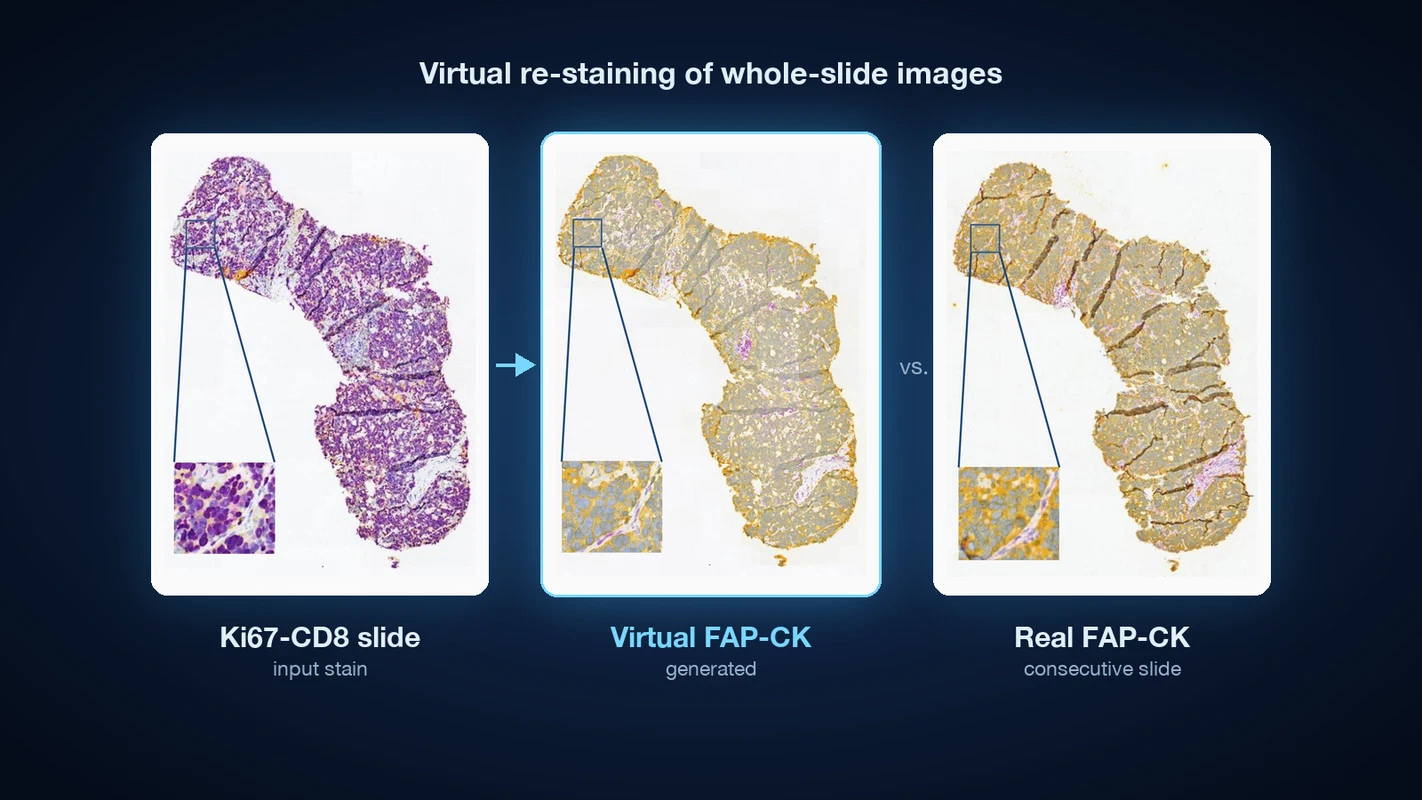
Industry project with Roche Diagnostics on virtual staining in digital pathology — generating immunohistochemistry stains from tissue images with unsupervised GANs, seamlessly across gigapixel whole slide images, and segmenting multistain slides for biomarker research (2016–2020).
Abstract
Histopathological evaluation is central to diagnosis and drug development, especially in oncology. Beyond the standard H&E stain, target-specific stains such as immunohistochemistry (IHC) are often needed — but tissue is scarce, staining is slow and costly, and every additional stain consumes another tissue section. Cancer-immunotherapy biomarker research adds the burden of manually annotating multistain slides.
What we did
- Segmenting multistain slides from one shot. A fully convolutional network with one-shot colour deconvolution segments digitised slides with multiple stainings into tumour, healthy tissue, necrosis and background, generalising across immunohistochemistry stains to reduce pathologists’ annotation workload (IET Image Processing 2019).
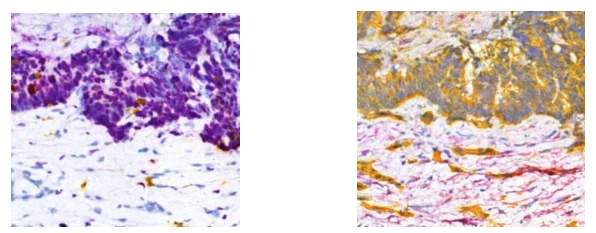
- Virtualizing the stain. Unsupervised style-transfer GANs generate realistic, clinically meaningful images of stained tissue — for example FAP-CK immunofluorescence from other stainings — opening the way to in-silico multiplexing of several stains on the same tissue section (European Congress on Digital Pathology 2019).
- Seamless at gigapixel scale. Whole slide images must be processed tile by tile, and instance normalization leaves visible tiling artifacts when the tiles are stitched back together. A perceptual embedding consistency loss removes these artifacts (MICCAI 2019), and the full framework was validated for seamless virtual whole-slide synthesis (IEEE JBHI 2020).
Our role
Scientific lead as a postdoc at the Chair for Computer Aided Medical Procedures (TU Munich, PI: Nassir Navab), and co-supervision — with Eldad Klaiman (Roche Diagnostics, Penzberg) — of Amal Lahiani’s industrial PhD (2016–2020).
Perspective
The project showed that virtual staining can be made clinically interpretable and seamless at whole-slide scale, and seeded our later work on trustworthy digital staining in hematology.
Partner institutions




Publications 4
Seamless Virtual Whole Slide Image Synthesis and Validation Using Perceptual Embedding Consistency
IEEE Journal of Biomedical and Health Informatics, 2020
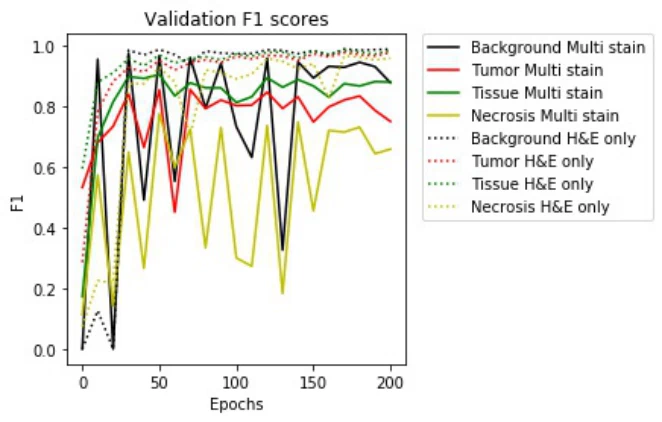
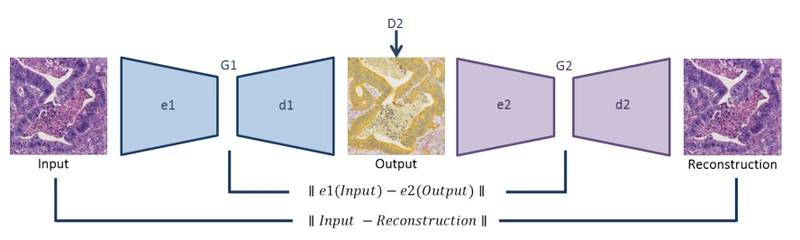
Perceptual Embedding Consistency for Seamless Reconstruction of Tilewise Style Transfer
Medical Image Computing and Computer Assisted Intervention – MICCAI 2019, Lecture Notes in Computer Science, 2019
Virtualization of tissue staining in digital pathology using an unsupervised deep learning approach
European Congress on Digital Pathology, 2019