Siemens X-ray
Optimisation of X-ray images with respect to image quality and dose
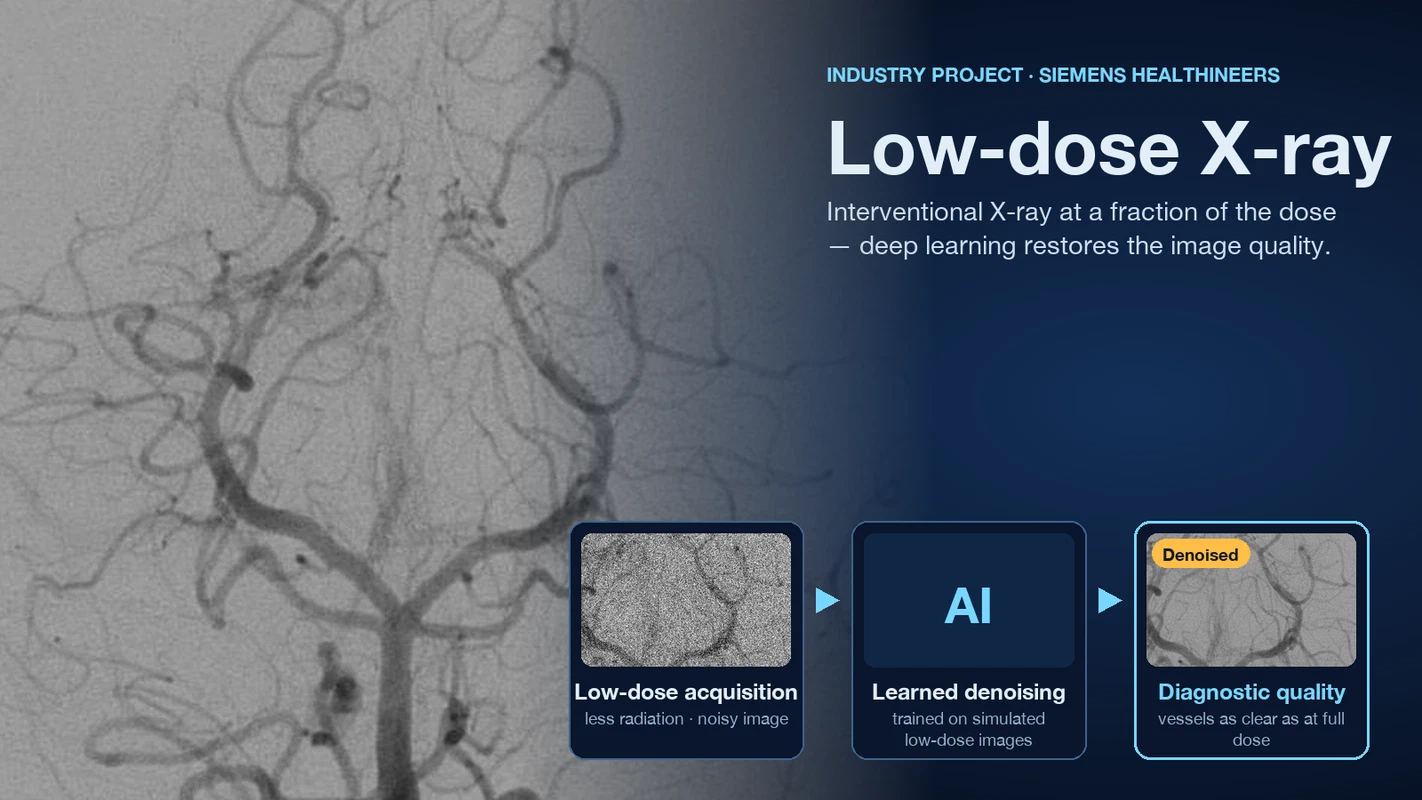
Industry project with Siemens Healthineers (Advanced Therapies, Forchheim) on lowering the X-ray dose of interventional imaging without losing image quality — noise-model-driven denoising of low-dose fluoroscopy and angiography, and a real-time learning-based denoiser trained on simulated low-dose images.
Abstract
X-ray guidance is at the heart of interventional procedures, but it exposes patients — and clinical staff, over a whole career — to ionising radiation. Following the “as low as reasonably achievable” principle, the dose can only be lowered if the image quality is kept, yet lower dose means fewer photons and noisier images, and at very low dose conventional denoisers oversmooth or create artefacts. Supervised deep learning would need aligned low- and high-dose image pairs, which cannot ethically be acquired during an intervention.
What we did
- Photon recycling for ultra-low-dose sequences. A patch-based spatio-temporal denoiser with a properly parameterised Poisson–Gaussian noise model exploits non-local self-similarity across frames and low-rank approximation, without needing an initial estimate — better denoising at lower computational cost (IJCARS 2018).
- Low-dose digital subtraction angiography. Spatially aligned DSA frames vary mainly through the flow of contrast agent, so a constrained, weighted rank-1 approximation of the temporal stack denoises each frame — evaluated with an advanced neurovascular replication system towards reducing both X-ray dose and contrast agent (IJCARS 2019).
- Learning to denoise without clean images. A model-based simulation of realistic low-dose X-ray images — accounting for system gain, electronic noise and detector blur — generates training data from routine acquisitions, and the same imaging model normalises the input through noise-variance stabilisation. The resulting real-time network outperformed BM3D and WNNM on phantom and clinical data and was preferred by experts for sharp, artefact-free and realistic results (MICCAI 2019).
Our role
Scientific lead of the project as postdoc at TUM CAMP under Nassir Navab (PI and main supervisor), and mentoring of Sai Gokul Hariharan’s industrial PhD, run jointly with Norbert Strobel and Markus Kowarschik at Siemens Healthineers and completed at TU Munich in 2023.
Perspective
The thesis concluded that the X-ray dose can be reduced substantially without sacrificing clinically relevant information; the work continued at Siemens Healthineers in patents on X-ray noise reduction.
Partner institutions




Publications 3

Learning-based x-ray image denoising utilizing model-based image simulations
Medical Image Computing and Computer Assisted Intervention – MICCAI 2019, Lecture Notes in Computer Science, 2019
Preliminary results of DSA denoising based on a weighted low-rank approach using an advanced neurovascular replication system
International journal of computer assisted radiology and surgery, 2019
A photon recycling approach to the denoising of ultra-low dose X-ray sequences
International journal of computer assisted radiology and surgery, 2018