SyriaLeishAI+: Multimodal machine learning for AI-based diagnosis of cutaneous leishmaniasis in Syria
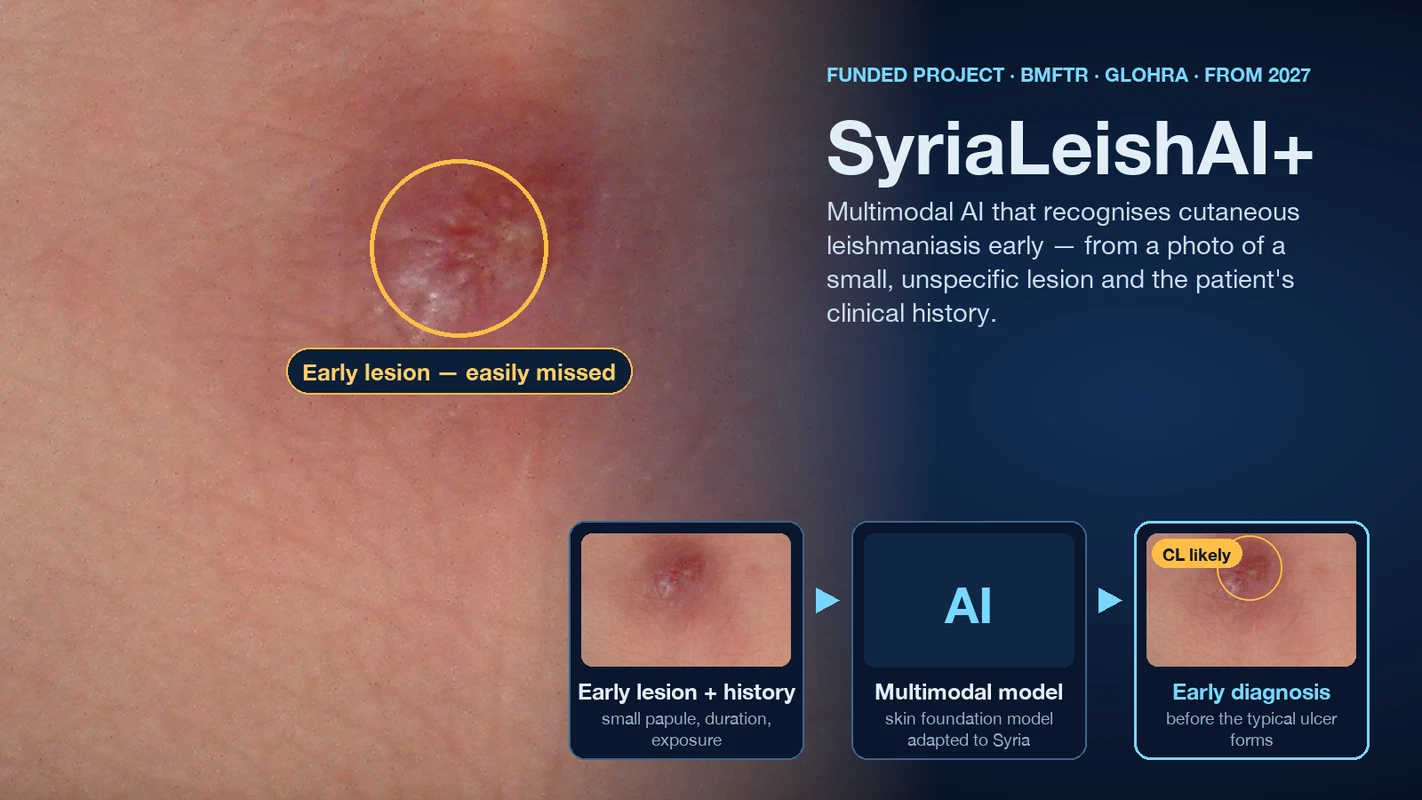
A proof-of-concept study that develops and validates a multimodal AI model for diagnosing cutaneous leishmaniasis in Syria, combining lesion photographs with clinical and epidemiological information, and builds an open, FAIR dataset from one of the regions most affected by the disease.
Abstract
Cutaneous leishmaniasis (CL) is a neglected tropical disease that mainly affects marginalised communities. Besides the skin lesions and scars, it often brings stigma and economic loss. Syria carries one of the highest CL burdens worldwide, made worse by the conflict-related collapse of the health system and limited access to diagnosis. AI tools such as the WHO Skin NTDs App can help health workers recognise CL with little training — but existing image datasets under-represent Southwest Asia, where most cases occur, and current tools rarely use information beyond the lesion photo.
SyriaLeishAI+ develops and validates a multimodal machine-learning model for CL detection tailored to the Syrian context. It combines lesion images with clinically relevant metadata such as disease duration and exposure to risk factors.
Approach
To cope with scarce data, the model is trained by progressive transfer learning in three stages:
- Skin foundation model — pre-trained on large public dermatology image collections (ISIC, Fitzpatrick17k) and adapted to learn skin-tone-aware representations.
- Multimodal CL model — fine-tuned on CL images with associated metadata, provided by CIDEIM, a WHO collaborating centre for leishmaniasis.
- Adaptation to Syria — careful fine-tuning with domain adaptation on high-quality data from Syria.
A prospective study in Syria will enrol 500 people with suspected CL, with diagnoses confirmed by expert clinical assessment and PCR. The data are split in advance: 300 participants for training and internal validation, and 200 held out for an independent evaluation with subgroup analyses to uncover possible bias.
Why it matters
Unlike existing digital tools for skin NTDs, which rely on lesion images alone, SyriaLeishAI+ combines complementary data streams to capture the complexity of CL — an approach that has improved diagnosis in other areas of dermatology but has not yet been validated for CL. The project will also produce a systematically collected, multimodal, FAIR dataset from Syria, closing a geographic and equity gap in AI training data.
In line with WHO priorities for access to NTD diagnostics, the aim is to shorten diagnostic delays and support clinical decisions in decentralised and humanitarian health systems. The approach can be transferred to other settings and extended to other skin NTDs. Local stakeholders and partner-led dissemination through global-health networks will help the results inform WHO guidance and national policy.
Consortium
The project brings together AI model development (Albarqouni Lab, University Hospital Bonn), epidemiology and clinical-study expertise (Prof. Claudia Denkinger, Heidelberg University Hospital), and humanitarian implementation experience in Syria (The MENTOR Initiative), with technical guidance from the WHO Skin NTD team and CIDEIM. The project runs for 24 months from January 2027, funded by the German Federal Ministry of Research, Technology and Space (BMFTR) through the German Alliance for Global Health Research (GLOHRA).
Work packages
| WP | Title | Lead | Our role |
|---|---|---|---|
| WP1 | Management, ethics and dissemination Project coordination, study protocol, ethics approvals, data governance, publications and stakeholder engagement (months 1–24). | Partner | |
| WP2 | Data acquisition and study implementation Retrospective cutaneous-leishmaniasis datasets and a prospective clinical study in Syria collecting standardised lesion images and clinical metadata (months 1–18). | Partner | |
| WP3 | AI model development and evaluation A multimodal machine-learning model for detecting cutaneous leishmaniasis, trained on the retrospective and prospective data, with external evaluation and bias assessment (months 4–18). | UKB | Lead |