Telemedicine in Palestine
Between 2007 and 2014, a proposal for a telemedicine centre in the Gaza Strip — medical equipment on a private network and a platform built on electronic health records (EHB and EMMIT 2009) — followed by a review of Palestinian telemedicine initiatives and their shared barriers at a telemedicine conference with Palestinian hospitals and GIZ in Ramallah (2014).
Abstract
Between 2007 and 2014, I worked on bringing telemedicine to the Gaza Strip and the wider Palestinian health system. In Gaza, I developed a proposal for a telemedicine center. It would prepare the IT infrastructure by connecting medical equipment to a private network and building a platform backed by patients’ electronic health records. I presented the proposal at the 2nd International Conference on e-Health and Bioengineering (EHB 2009) in Iași, Romania. Later that year I presented it at the EMMIT 2009 conference in Beirut, by live videoconference from the Gaza Strip.
In 2014, as a PhD candidate at the Technical University of Munich, I joined the Telemedicine Conference in Ramallah, bringing together Palestinian hospitals and GIZ, by Skype. There I reviewed earlier Palestinian telemedicine initiatives and identified administrative engagement, physician engagement, infrastructure and sustainability as the main barriers they shared.
Context: telemedicine in Palestine before 2009
Checkpoints, travel permits and the separation between the West Bank and Gaza made it hard for patients and physicians to reach each other, and several initiatives turned to telemedicine in the 2000s. These were separate projects with different partners; the sources below document what each of them set out to do.
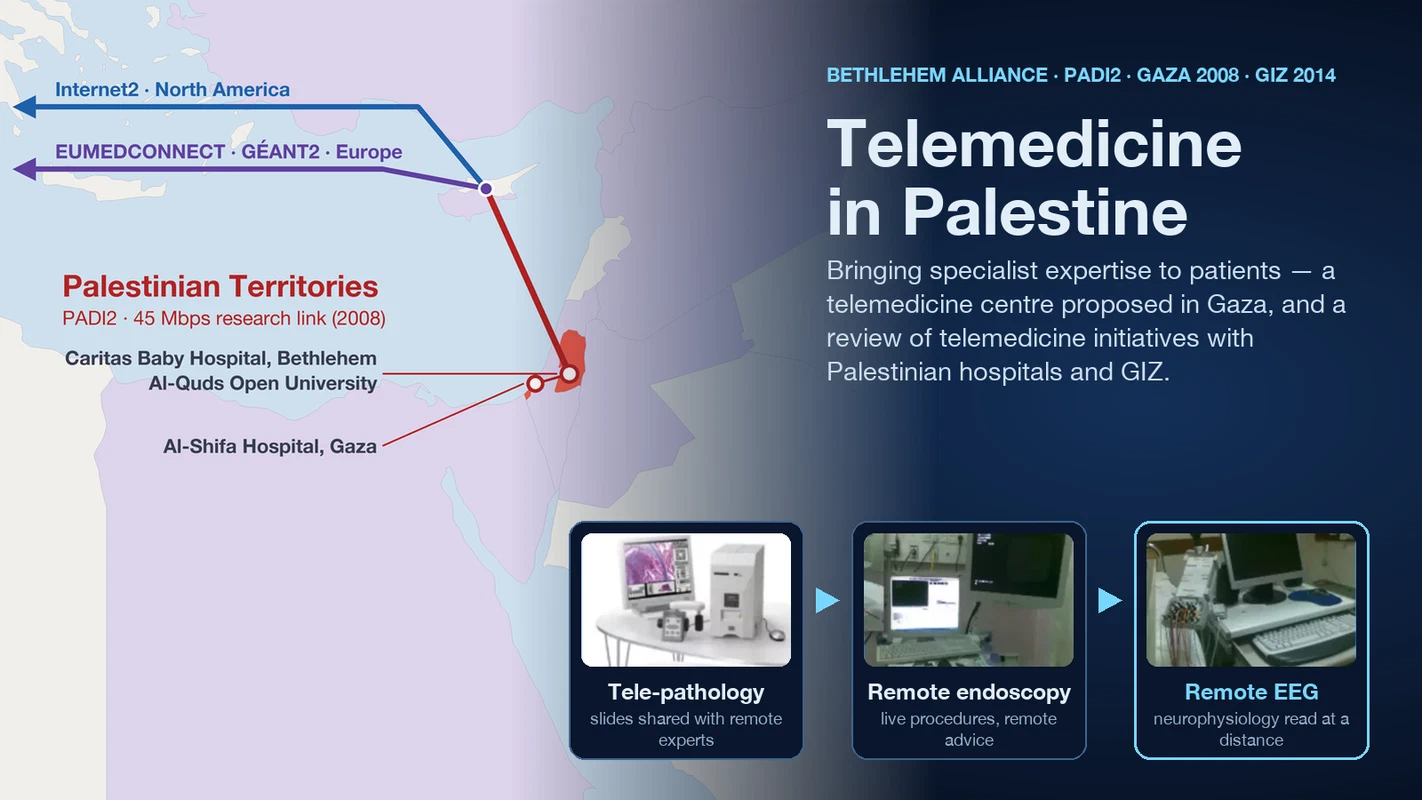
- The Bethlehem Alliance and PADI2 (2004–2008). James O. Whitlock of the University at Buffalo’s Western New York High Performance Networked Video Initiative facilitated the Bethlehem Alliance, which aimed to promote a Palestinian national research and education network (NREN) and to demonstrate high-quality videoconferencing for medical consultation and education. His April 2008 presentation to the Internet2 working group on emerging NRENs lists its milestones: the first known IP videoconference on the Palestinian Internet (2004); the founding of a Palestinian university consortium, the Palestinian Association for the Development of Internet2 (PADI2), and the installation of an EU-funded international connector (2005); Caritas Baby Hospital in Bethlehem taking part online in an Internet2 meeting in San Diego (2007); and by 2008 stable systems at Caritas Baby Hospital, Al-Shifa Hospital in Gaza and Al-Quds Open University, with “medical applications next” [1]. A UN-ESCWA report from 2007 likewise describes how, from 2005, universities and research centres mostly around Bethlehem founded PADI2 to become the Palestinian partner of EUMEDCONNECT, noting that funding delayed the complete link-up [2].
- EUMEDCONNECT and GÉANT. EUMEDCONNECT, run by DANTE, linked the research and education networks of the southern and eastern Mediterranean to each other and, through GÉANT2, to Europe, North America (including Internet2’s Abilene network) and beyond. By 2008 it listed the Palestinian Territories — through Birzeit University and Al-Quds Open University — as connected at 45 Mbps [3]. This was a research and education link; the sources do not show that it carried clinical traffic for individual hospitals.
- The Italian telemedicine network (2006). Supported by TELBIOS and the Italian Association for Solidarity among Peoples (AISPO) under the patronage of the Italian Foreign Ministry, it connected eight clinical sites — among them Shifa Hospital and the European Hospital in Gaza — with ISDN videoconferencing, web-based teleconsultation requests, tele-pathology in two hospitals and e-learning; in March 2006 it was reported as tested and ready for use [4].
- The Palestinian Telemedicine Rehabilitation Network (2006–2010). Funded mainly by the Norwegian Ministry of Foreign Affairs and implemented with the Norwegian Centre for Integrated Care and Telemedicine, it linked the four national rehabilitation centres in Ramallah, Jerusalem, Beit Jala and Gaza (El Wafa Hospital) with each other and with expertise abroad, combining videoconferencing and e-learning [5], [2].
- The GIZ telemedicine network. Within its Open Regional Fund, commissioned by the German Federal Ministry for Economic Cooperation and Development (BMZ), GIZ supported a customised online telemedicine application that allows Palestinian doctors to seek second opinions — for example between Beit Jala Hospital and the King Hussein Cancer Center in Amman [8].
What I did
- 2008 — the first connection. Within the Bethlehem Alliance and PADI2, I contributed to establishing the first connection in 2008 that brought stable systems to Caritas Baby Hospital, Al-Shifa Hospital in Gaza and Al-Quds Open University.
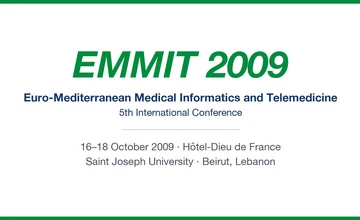
- 2007–2009 — a telemedicine center for Gaza. I took the initiative to develop this further into a proposal for a telemedicine center — “not only videoconferencing”, but connecting medical equipment to a private network, such as digital pathology for tele-pathology, and remote endoscopy and remote EEG for tele-monitoring and tele-consultation, on a platform supported by the patient’s electronic health record, to enable telemedicine in Palestine. I discussed the achievements and challenges of telemedicine in Palestine at the Third IT Forum of the Islamic University of Gaza in May 2009 [6], and presented the proposal at EHB 2009 [7] and, by videoconference from Gaza, at EMMIT 2009 in Beirut [9].
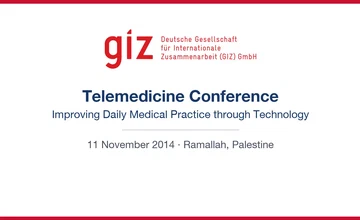
- 2014 — challenges and prospects. At the telemedicine conference Improving Daily Medical Practice through Technology (Ramallah, 11 November 2014), held by GIZ with Palestinian hospitals, I joined by Skype and reviewed four initiatives — the Italian project, the Norwegian rehabilitation network, the Bethlehem Alliance’s attempt to use EUMEDCONNECT, and my Gaza proposal — and the barriers they shared: administrative engagement, physician engagement, lack of adequate infrastructure and sustainability. I also recommended aligning the network’s practices with the privacy and security guidelines of the American Telemedicine Association.
Conference talks
- Achievements and challenges of telemedicine in Palestine. Third IT Forum “Towards an Information Society”, College of Information Technology, Islamic University of Gaza, 12–13 May 2009 [6].
- Steps towards establishing telemedicine center in Palestine. 2nd International Conference on e-Health and Bioengineering (EHB 2009), Iași, Romania, September 2009 (paper) [7].
- Steps towards establishing telemedicine center in Palestine (by videoconference from Gaza). 5th International Conference on Euro-Mediterranean Medical Informatics and Telemedicine (EMMIT 2009), session “Telemedicine and Telecare Systems and Services”, Hôtel-Dieu de France, Beirut, Lebanon, 16 October 2009 (talk page) [9].
- Telemedicine in the Palestinian Territories: Challenges and prospects (via Skype). Telemedicine Conference: Improving Daily Medical Practice through Technology, Palestinian hospitals and GIZ, Ramallah, 11 November 2014 (talk page).
Sources
- J. O. Whitlock, The Bethlehem Alliance: Facilitating Public Benefit Next Generation Internet Development, presentation to the Internet2 SIG for Emerging National Research and Education Networks, Washington, DC, 21 April 2008 (archived PDF).
- UN-ESCWA, National Profile of the Information Society in Palestine, 2007, sections on research networking (p. 8) and e-health (PDF).
- DANTE, The EUMEDCONNECT Network — status table and topology, 2008 (archived page); see also PADI2’s website (archived, 2008).
- Agenzia Fides, “In Palestine, Wing for Healing: Italian tele-medicine for peace”, 14 March 2006 (article).
- J.-H. Olsen, Palestine Telemedicine Rehabilitation Network, NST report 03-2010, Norwegian Centre for Integrated Care and Telemedicine, 2010 (PDF).
- Islamic University of Gaza, news on the Third IT Forum, 12 May 2009 (Arabic) (article).
- S. N. Albarqouni, “Steps towards establishing telemedicine center in Palestine”, in H.-N. Costin (ed.), Advancements of Medical Bioengineering and Informatics: Proceedings of EHB 2009, Iași, 17–18 September 2009, p. 46, ISSN 2066-7590.
- GIZ, Open Regional Fund (ORF), project page, commissioned by BMZ, 2013–2017 (giz.de).
- EMMIT 2009 programme, Beirut, 16–18 October 2009 (archived PDF).
Partner institutions


Publications 1
Steps towards Establishing Telemedicine Center in Palestine
Advancements of Medical Bioengineering and Informatics: Proceedings of the 2nd International Conference on e-Health and Bioengineering (EHB 2009), Iași, Romania, 2009