Modelling Uncertainty in Deep Learning for Medical Applications
DAAD Funded Project with ETH Zürich and Imperial College London (2020-2022)
Abstract
Deep Learning has emerged as a leading technology for accomplishing many challenging tasks showing outstanding performance in a broad range of applications in computer vision and medical applications. Despite its success and merit in recent state-of-the-art methods, DL tools still lack in robustness hindering its adoption in medical applications. Modeling uncertainty, through Bayesian Inference and Monte-Carlo dropout, has been successfully introduced to computer vision for better understanding the underlying deep learning models. In this proposal, we investigate modeling the uncertainty for medical applications given the well-known challenges in medical image analysis, namely severe class-imbalance, few amounts of labeled data, domain shift, and noisy annotations.
Partner institutions






Publications 7

Eyelid Tumor Triage using Uncertainty-Aware and Explainable Artificial Intelligence
124th DOG Congress (Deutsche Ophthalmologische Gesellschaft), Berlin, 24–27 September 2026, 2026

The OOD Blind Spot of Unsupervised Anomaly Detection
Medical Imaging with Deep Learning, 2021
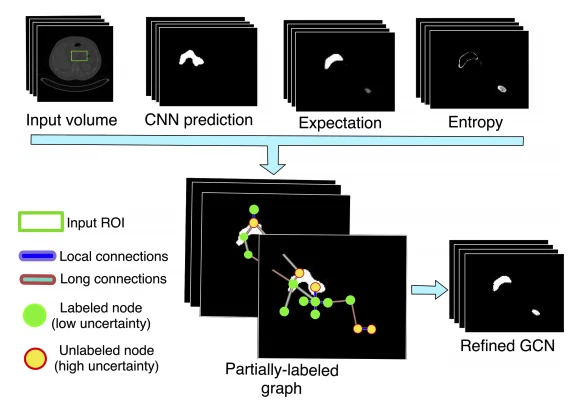
An Uncertainty-Driven GCN Refinement Strategy for Organ Segmentation
Journal of Machine Learning for Biomedical Imaging (MELBA) — Special Issue: MIDL 2020, 2020
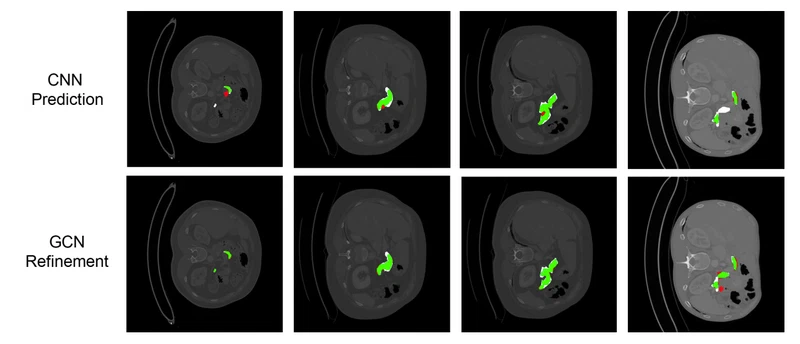
Uncertainty-based graph convolutional networks for organ segmentation refinement
To appear in the International Conference in Medical Imaging with Deep Learning, 2020, 2020

Bayesian Skip-Autoencoders for Unsupervised Hyperintense Anomaly Detection in High Resolution Brain Mri
2020 IEEE 17th International Symposium on Biomedical Imaging (ISBI), 2020

Can we trust AI? Investigating uncertainty in unsupervised brain anomaly detection
Clinical Neuroradiology, 2019
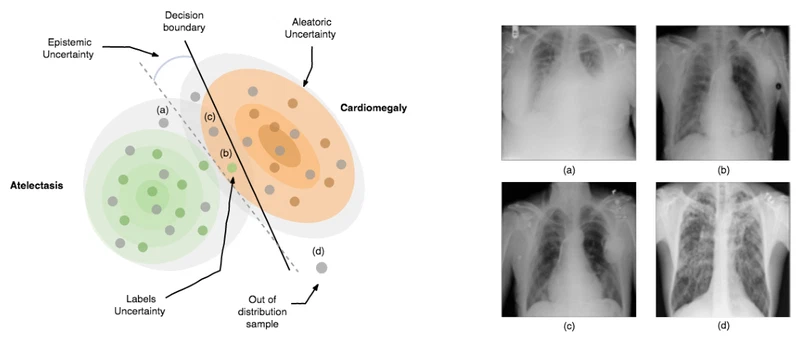
Learn to estimate labels uncertainty for quality assurance
arXiv preprint arXiv:1909.08058, 2019