ZEISS Representation Learning
Disentangled, fair and discriminative representations for ophthalmic imaging
Industry project with Carl Zeiss Meditec on representation learning for medical imaging — microaneurysm segmentation for diabetic-retinopathy screening, interpretable disentangled representations, and representations that are invariant to sensitive attributes for fair and privacy-preserving AI.
Abstract
Data-driven models only reach clinical practice if what they learn is discriminative enough for subtle findings, compact and interpretable enough to be inspected, and free of information it should not rely on. Together with Carl Zeiss Meditec, the project addressed all three through representation learning, starting from retinal imaging for diabetic-retinopathy screening.
What we did
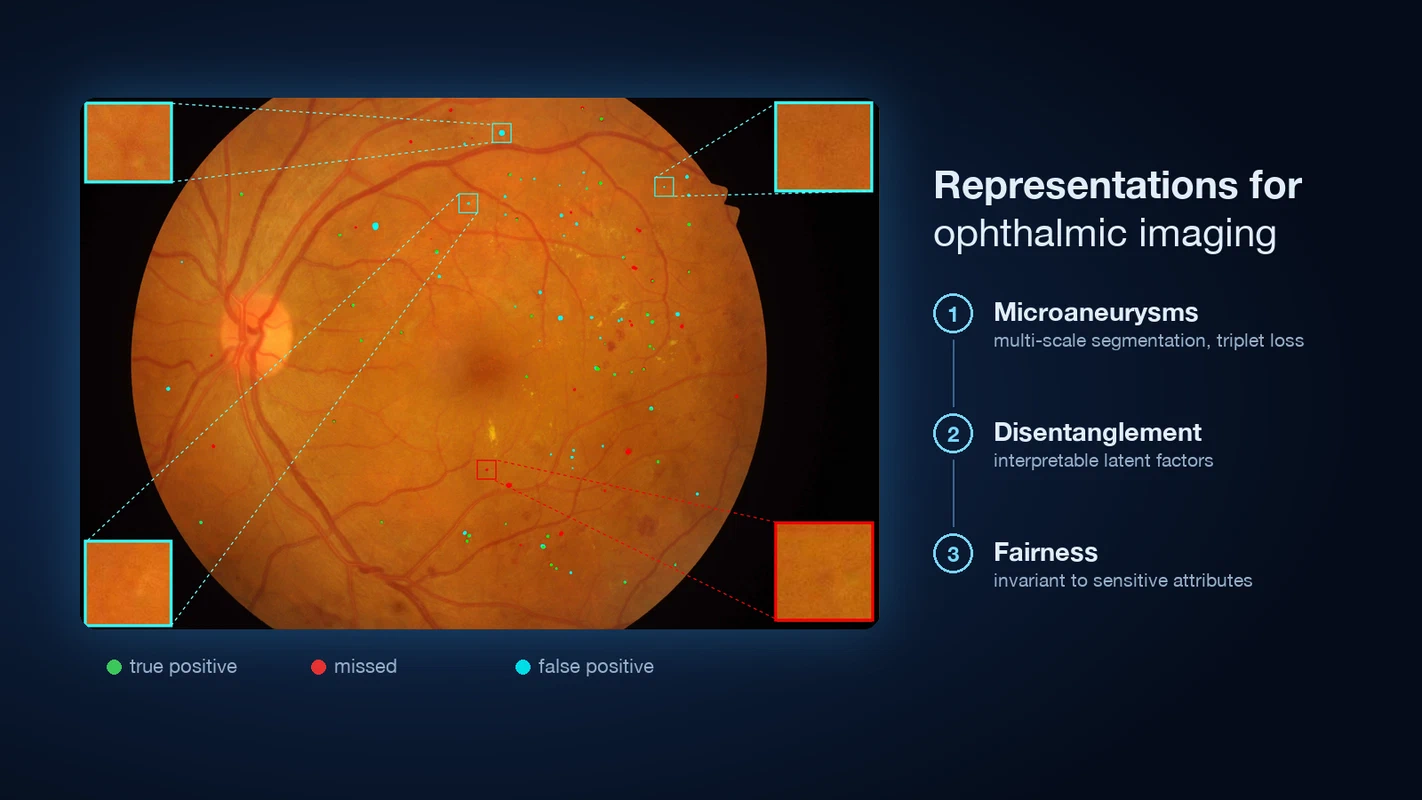
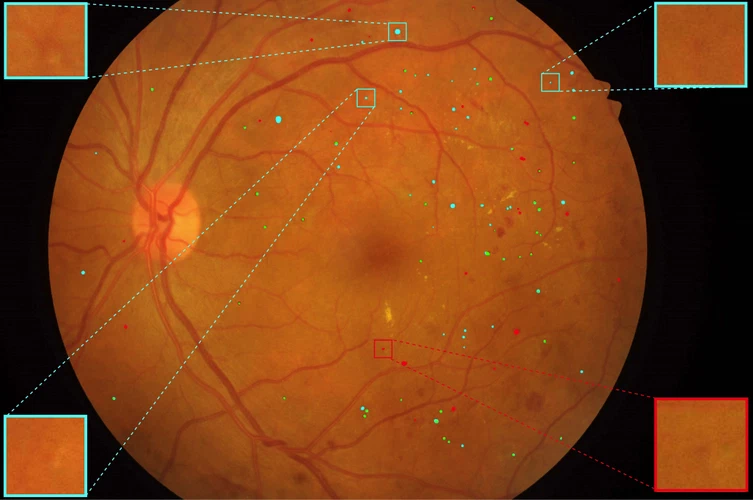
- Finding the smallest lesions. Microaneurysms are the earliest visible sign of diabetic retinopathy and occupy only a few pixels of a fundus image. A two-stage approach segments them on multiple scales with a region-proposal fully convolutional network, then refines the candidates with a patch-wise network trained with an embedding triplet loss and selective sampling of hard patches — a 30% relative improvement over a plain fully convolutional network (MICCAI 2019; extended in IET Image Processing).
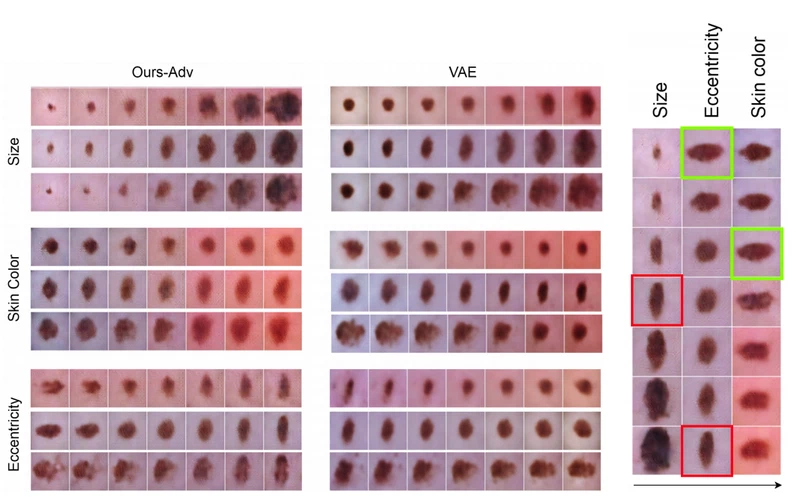
- Interpretable latent spaces. An adversarial variational autoencoder with a total-correlation constraint enforces independent latent factors while keeping reconstruction fidelity, improving disentanglement by 81.5% and making the representation useful for clustering and for classification with few labels (DART @ MICCAI 2019).
- Fairness by orthogonal disentanglement. Splitting the representation into a target code and a sensitive code, enforcing orthogonality between them and maximising the entropy of the target code with respect to the sensitive attribute yields representations that are invariant to it — state of the art on three of five benchmarks (ECCV 2020) — and carries over to privacy-preserving medical applications such as autism detection and healthcare insurance (DART/DCL @ MICCAI 2020).
Our role
Scientific lead of the project as postdoc at TUM CAMP under Nassir Navab, and co-supervision — with Abouzar Eslami (Carl Zeiss Meditec) — of Hasan Sarhan’s industrial PhD, completed at TU Munich in 2024.
Perspective
The work on disentangled and orthogonal representations became a building block of our later research on fairness, privacy and federated learning in medical imaging.
Partner institutions



Publications 5

Fairness by Learning Orthogonal Disentangled Representations
16th European Conference on Computer Vision (ECCV), 2020
On the Fairness of Privacy-Preserving Representations in Medical Applications
Domain Adaptation and Representation Transfer, and Distributed and Collaborative Learning — DART 2020 and DCL 2020 workshops @ MICCAI, Lecture Notes in Computer Science, 2020
Learning interpretable disentangled representations using adversarial vaes
Domain Adaptation and Representation Transfer and Medical Image Learning with Less Labels and Imperfect Data, 2019
Multi-scale Microaneurysms Segmentation Using Embedding Triplet Loss
International Conference on Medical Image Computing and Computer-Assisted Intervention, 2019