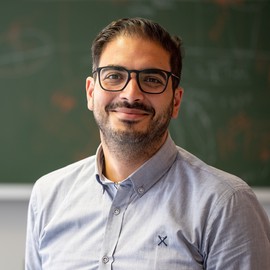
Seminar: Computational Medical Imaging (CoMI)
 Image created with assistance from DALL·E for the CoMI Seminar at the University of Bonn.
Seminar: Computational Medical Imaging (CoMI)
- Lecturers: Prof. Dr. Shadi Albarqouni
- Module: MA-INF 2318
- Credits: 2 SWS, 4 CP (120 h workload)
- Programme: M.Sc. Computer Science
- Language: English
- Format: Seminar (2 SWS)
- Time: Thursdays, 14:00 – 16:00
- Location: TBD, INF 6+8
Description
The Computational Medical Imaging (CoMI) seminar provides an opportunity for students to explore, understand, and critically evaluate contemporary research in computational medical imaging — from classical algorithms to modern deep learning-based techniques.
Participants analyze recent publications from leading journals and conferences, deepening their understanding of medical image segmentation, registration, classification, uncertainty quantification, and bias/causality in imaging. The seminar emphasizes both technical expertise and scientific communication skills.
Learning Goals
Technical Skills
- Understand and critically appraise current research in computational medical imaging.
- Deepen expertise in medical image segmentation, registration, classification, uncertainty quantification, and bias/causality.
- Extract core contributions from scientific papers and position them in the context of the state-of-the-art.
Soft Skills
- Develop competence in independent literature search and paper analysis.
- Present complex research effectively (written and oral), with appropriate visual and didactic support.
- Engage in critical discussions and defend arguments scientifically.
- Practice time management and constructive peer feedback.
Topics and Focus Areas
Seminar topics are drawn from recent publications in top-tier venues and may include:
- Segmentation & Classification (e.g., anatomical structure delineation, lesion detection)
- Registration & Alignment (e.g., atlas-based or diffeomorphic registration)
- Quantitative Imaging & Radiomics (feature extraction, prognostic modeling)
- Uncertainty Quantification & Bias (Bayesian learning, causal inference, dataset shift)
- Deep Learning Architectures (U-Nets, GANs, Vision Transformers)
- Ethical, Regulatory, and Clinical Translation Aspects
🗓 Seminar Schedule (Winter 2025/26)
| Date | Theme | Description | Presenter | Key References / Papers |
|---|---|---|---|---|
| 23 Oct 2025 | Kick-off & Introduction | Overview of seminar format, expectations, topic assignments. | Course Team | Duncan, J.S. and Ayache, N., 2002. Medical image analysis: Progress over two decades and the challenges ahead. IEEE transactions on pattern analysis and machine intelligence, 22(1), pp.85-106. PDF |
| 30 Oct 2025 | Foundations of Computational Medical Imaging | Classical image processing and analysis methods. | Gonzalez & Woods, Digital Image Processing, Ch2-Ch4 | |
| 06 Nov 2025 | Segmentation and Classification | Delineation of anatomical structures and lesion detection. | Gonzalez & Woods, Digital Image Processing, Ch10-Ch12, Litjens et al., Med Image Anal 42 (2017) | |
| 13 Nov 2025 | Registration and Alignment | Image registration methods: deformable, atlas-based, and deep learning approaches. | Rueckert, D. and Schnabel, J.A., 2010. Medical image registration. In Biomedical image processing (pp. 131-154). Berlin, Heidelberg: Springer Berlin Heidelberg. PDF; Sotiras et al., IEEE TMI 32(7):1153–1190 (2013) PDF. | |
| 20 Nov 2025 | Quantitative Imaging & Radiomics | Feature extraction, radiomic biomarkers, and prognostic modeling. | Lambin et al., Eur J Cancer 48 (2012) PDF; McCague, C., et al. “Introduction to radiomics for a clinical audience.” Clinical Radiology 78.2 (2023): 83-98. PDF. | |
| 27 Nov 2025 | Deep Learning Architectures I | Convolutional Neural Networks, U-Nets for image segmentation and classification. | Goodfellow, Ian, et al. Deep learning. Vol. 1. No. 2. Cambridge: MIT press, 2016. Ch-9 PDF; Ronneberger et al., MICCAI 2015 PDF; | |
| 04 Dec 2025 | Deep Learning Architectures II | Generative Adversarial Networks, Vision Transformers, and self-supervised learning. | Goodfellow, Ian, et al. Deep learning. Vol. 1. No. 2. Cambridge: MIT press, 2016. Ch-20 PDF; Goodfellow et al. 2020 PDF, Isola et al., CVPR 2017 PDF | |
| 11 Dec 2025 | Uncertainty Quantification | Probabilistic and non-probabilistic approaches to quantifying model uncertainty. | Huang et al., Med Image Anal (2024) PDF. | |
| 18 Dec 2025 | Causality and Bias in Medical Imaging | Causal reasoning and dataset bias in deep learning for medical applications. | Castro et al., Nat Commun 11 (2020) PDF; Mittermaier, Mirja, Marium M. Raza, and Joseph C. Kvedar. “Bias in AI-based models for medical applications: challenges and mitigation strategies.” NPJ Digital Medicine 6.1 (2023): 113. PDF; Chinta, Sribala Vidyadhari, et al. “AI-Driven Healthcare: A Review on Ensuring Fairness and Mitigating Bias.” arXiv preprint arXiv:2407.19655 (2024). PDF | |
| 08 Jan 2026 | Ethics & Clinical Translation | Regulatory and ethical challenges of AI in healthcare. | Topol E., Nature Med 25 (2019) PDF; Lekadir, Karim, et al. “FUTURE-AI: international consensus guideline for trustworthy and deployable artificial intelligence in healthcare.” bmj 388 (2025). PDF | |
| 15 Jan 2026 | Student Paper Presentations I | Student presentations and peer feedback. | Students | — |
| 22 Jan 2026 | Student Paper Presentations II | Continuation of student presentations. | Students | — |
| 29 Jan 2026 | Student Paper Presentations III | Final student session and discussion. | Students | — |
| 05 Feb 2026 | Course Wrap-Up & Outlook | Summary of insights and future directions in computational medical imaging. | Course Team | — |
Learning Format
Students independently select and present recent research papers in computational medical imaging, fostering discussion and critical evaluation within the seminar group.
- Group Presentation: A group of 2-3 Students will present a topic and raise some discussions among the students. They will be asked to write a written summary as a lecture note on their topic (15-20 pages).
- Individual Presentation: Each individual will present a relevant paper of her/his choice at the end of the semester
Recommended Prerequisites
At least one of the following:
- MA-INF 2222 – Visual Data Analysis
- MA-INF 2312 – Image Acquisition and Analysis in Neuroscience
A solid background in Python programming, linear algebra, probability, and numerical algorithms is recommended.
References and Resources
Relevant Journals:
- Nature Machine Intelligence
- Medical Image Analysis (MedIA)
- IEEE Transactions on Medical Imaging (TMI)
- Radiology: AI, European Radiology, IEEE Journal of Biomedical and Health Informatics
Relevant Conferences:
- MICCAI (Medical Image Computing & Computer-Assisted Intervention)
- CVPR (IEEE/CVF Computer Vision and Pattern Recognition)
- MIDL (Medical Imaging with Deep Learning)
- ISBI (International Symposium on Biomedical Imaging)
- RSNA (Radiological Society of North America Annual Meeting)
Registration
Registration takes place via eCampus or by contacting Prof. Dr. Shadi Albarqouni.