HAICON 2026 – AI for Science Conference
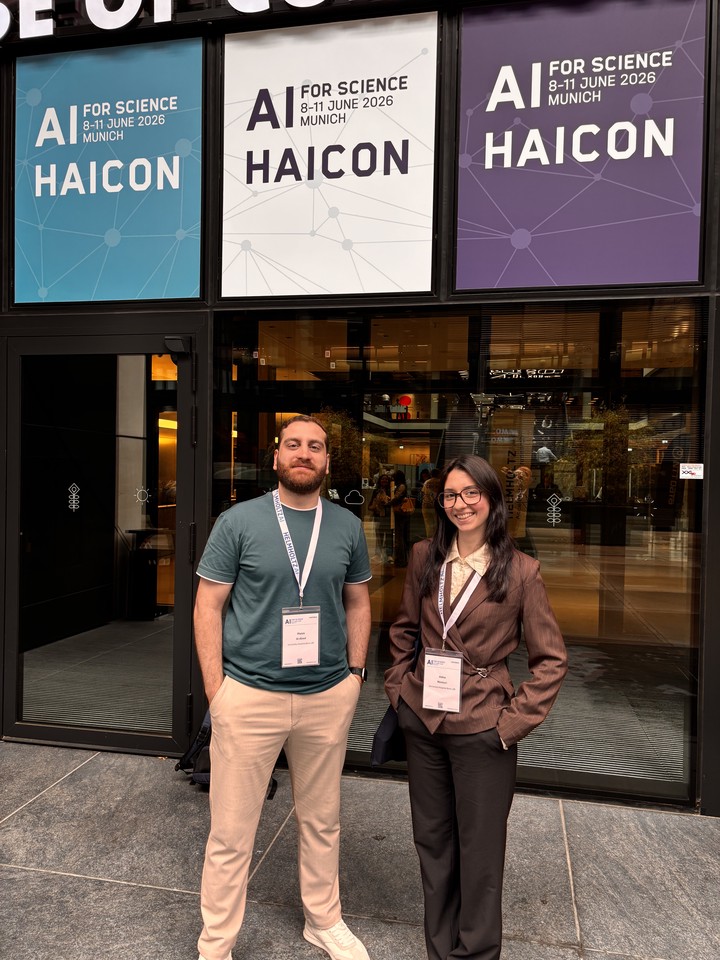 HAICON 2026
Malek and Adea attended the Helmholtz AI conference – HAICON 2026 – where they presented posters of the lab’s recent accepted papers at ISBI 2026: MRIQT, and MICCAI 2026: K-MaT and PromptGate. Beyond presenting the posters, Malek and Adea attended hands-on workshops, held during the first day, on Foundation Models, Causal AI and Quantum Machine Learning where the organizers introduced the topics, presented the latest trends and gave tutorials. They participated in the side-coffee networking events, connecting with fellow researchers , engaging in interesting talks about Agentic AI, Image Analysis and the use of LLMs for Sciences. The AI World Café featured speedy group discussions on hot-topics and concerning issues on AI like puplishing in the age of AI, ML models lifecycle management beyond research and the next wave of AI. These interactions are essential for advancing interdisciplinary research and ensuring that scientific innovations can be translated into meaningful real-world impact. Highlights of the conference included keynote talks by Pierre Gentine (Columbia University), Daniel Rückert (Technical University of Munich), and Cordelia Schmid (Inria and Google). Their presentations covered AI applications in climate science, medicine, and robotics, respectively, showcasing the breadth of AI-driven innovation and its growing role in advancing scientific research. In the last day, Malek and Adea were invited to the State Reception at the Munich Residenz by the Deputy Bavarian Minister-President Hubert Aiwanger. Minister Aiwanger stressed on the importance of pushing the AI research while holding strong communication between the local community, politicians and scientists for better transparency, trust and economical value.
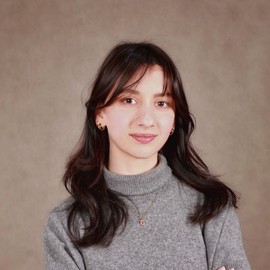
Adea Nesturi
PhD Candidate
Adea is currently a PhD candidate under the supervision of Prof. Dr. Shadi Albarqouni. She earned her master’s degree in Health Data Science from the University of St Andrews, Scotland, in 2024, where her research focused on the application of deep learning techniques for cancer detection. During her master’s program, she also contributed to the BraTS 2021 challenge, working on the segmentation of brain tumors (gliomas), which provided her with valuable experience in medical image analysis and collaborative research in international competitions.Adea’s research interests are centered on harnessing the power of deep learning to solve real-world medical challenges. She is particularly passionate about developing innovative technologies and AI-driven solutions that can directly improve patient care, enhance diagnostic accuracy, and optimize healthcare outcomes. Through her work at the Albarqouni Lab, she aims to bridge the gap between cutting-edge computational methods and practical applications in clinical settings, advancing the field of medical AI while addressing critical healthcare needs.
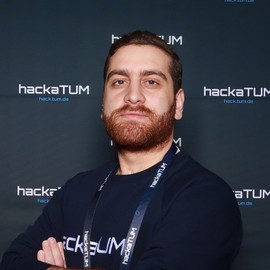
Malek Al Abed
Research Associate
Malek is a Research Associate at the University Hospital Bonn under the supervision of Prof. Dr. Shadi Albarqouni. He holds an M.Sc. in Biomedical Computing from TU Munich and completed his masters thesis at the University Hospital Bonn and TU Munich under the same supervision. His master’s thesis focused on image quality transfer for ultra-low-field MRI, with particular emphasis on the Hyperfine SWOOP system. Previously, he completed his undergraduate studies in Electrical Engineering at Kuwait University and undertook a research internship at Sony Stuttgart as a deep learning researcher, where he worked on audio recognition and human avatar technologies. Currently, his research focuses on the use of medical imaging in radiation therapy (iMRT and VMAT), particularly for dose optimization and personalized treatment planning. In addition, he works on developing an AI service and its corresponding API as part of the OMI protocol.
Jiajun Zeng
PhD Candidate
Jiajun Zeng is a PhD candidate at the University of Bonn, supervised by Prof. Shadi Albarqouni. He holds an MSc in Biomedical Engineering from Shenzhen University. During his master’s studies, he focused on AI for ultrasound image computing under the supervision of Assoc. Prof. Ruobing Huang and Prof. Dong Ni. His research interests span AI for healthcare, particularly in enhancing radiologists’ workflows through anatomical structure segmentation, disease diagnosis, and treatment support — with a focus on scenarios involving limited annotations and scarce computational resources. Currently, he is exploring efficient vision-language models and multimodal large language models for applications in the healthcare domain.