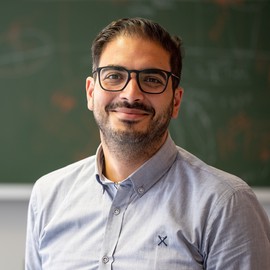
Lab: Computational Medical Imaging (CoMI)
 Image created with assistance from DALL·E for the CoMI Lab at the University of Bonn.
Lab: Computational Medical Imaging (CoMI)
- Lecturers: Prof. Dr. Shadi Albarqouni
- Tutors:
- Module: MA-INF 2230
- Credits: 4 SWS, 9 CP (270h workload)
- Programme: M.Sc. Computer Science
- Mode: Optional (2. or 3. Semester)
- Language: English
- Format: Lab (Praktikum), groups of max. 3 students
- Frequency: Every year
Description
The Computational Medical Imaging (CoMI) Lab is a project-based course in which students carry out a semester-long research project in computational medical imaging. Working in small groups, students identify a well-defined problem, collect or are provided a suitable dataset, implement baseline and novel approaches, and evaluate their results both quantitatively and qualitatively.
Possible project topics (chosen or proposed by the instructors) include:
- Anatomical Structure Segmentation (e.g., multi-atlas, CNN-based)
- Deformable Registration (e.g., classic demons, learning-based registration)
- Lesion/Anomaly Detection (e.g., out-of-distribution detection in X-ray)
- Radiomics & Quantitative Biomarker Extraction (e.g., texture features, deep radiomics)
- Uncertainty Estimation in Deep Learning (e.g., MC-Dropout, Bayesian networks)
- Causality & Bias Analysis in Medical Datasets (e.g., domain shift, fairness)
Learning Goals
Technical Skills
- Acquire a deep understanding of a selected problem in computational medical imaging: from problem identification to data processing, algorithm design, implementation, and evaluation.
- Implement, test, and validate state-of-the-art image-analysis algorithms (e.g., segmentation, registration, reconstruction, classification) on real medical data.
- Develop proficiency in using libraries and toolkits commonly used in medical imaging (e.g., ITK, SimpleITK, PyTorch for deep learning, nibabel/dipy).
- Learn to document software systematically (API documentation, code comments, unit tests) and to generate reproducible experiments (version control, containerization).
Soft Skills
- Collaborate effectively in small groups over the entire semester, dividing tasks (e.g., data curation, algorithmic implementation, evaluation).
- Prepare clear, concise technical documentation and design rationales.
- Present project progress and final results in oral form (midterm demo, final demo).
- Critically assess one’s own results and position them within the state-of-the-art in computational medical imaging.
🗓 Projects (Summer 2026)
Projects will be defined and announced at the beginning of the semester. Each group will work on one project throughout the semester.
| # | Topic | Description | Group |
|---|---|---|---|
| 1 | TBD | — | — |
| 2 | TBD | — | — |
| 3 | TBD | — | — |
Learning Format
Students work in groups of up to 3 on a semester-long project. Each group will:
- Identify a well-defined problem and collect or be provided a suitable dataset (publicly available or hospital data under ethics approval).
- Perform a literature review to select baseline methods.
- Implement baseline and at least one novel or improved approach.
- Evaluate quantitatively (e.g., Dice, Hausdorff, MSE, classification accuracy) and qualitatively (expert review where possible).
- Document the software (README, API docs) and provide a reproducible environment (Docker/Singularity).
- Present midterm progress (oral demonstration + short written summary) and final results (oral + poster or full report).
Assessment
Graded Exam:
Oral presentation (final demo + Q&A, 20 minutes per group). Written report (12–16 pages, including background, methods, results, discussion).
Ungraded Coursework (required for admission to the exam):
Project work; attendance in course sessions in accordance with the exam regulations of 2023, § 12(6).
Recommended Prerequisites
At least one of the following:
- MA-INF 2222 – Visual Data Analysis
- MA-INF 2312 – Image Acquisition and Analysis in Neuroscience
- MA-INF 2220 – Lab Visualization and Medical Image Analysis (or equivalent)
A solid background in Python programming (and/or C++), linear algebra, calculus, probability theory, and numerical algorithms is required. Familiarity with deep learning frameworks is highly recommended.
References and Resources
Relevant Journals:
- Nature Machine Intelligence
- Medical Image Analysis (MedIA)
- IEEE Transactions on Medical Imaging (TMI)
- Radiology: AI, European Radiology, IEEE Journal of Biomedical and Health Informatics
Relevant Conferences:
- MICCAI (Medical Image Computing & Computer-Assisted Intervention)
- CVPR (IEEE/CVF Computer Vision and Pattern Recognition)
- MIDL (Medical Imaging with Deep Learning)
- ISBI (International Symposium on Biomedical Imaging)
- RSNA (Radiological Society of North America Annual Meeting)
Registration
Registration takes place via eCampus or by contacting Prof. Dr. Shadi Albarqouni.